- Search Engine
- | About us
- | Index
- | History
- | The way we operate
- | Buying from us
- |
Our forthcoming Fairs - | Email us
- | Index of Research
- | Exchange Rates
- | Privacy & Security |
Early Writing-related silver:
ink-wells, seals, pens etc.

Click on |
Description — clicking on underlined text brings up extra full-size images of each piece |
Stock number |
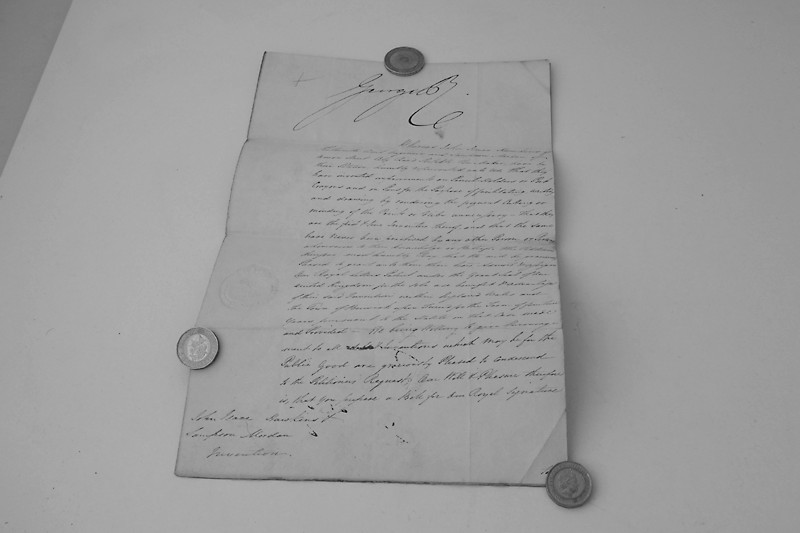 |
A George IV patent issued by George IV to Sampson Mordan and John Isaac Hawkins in 1822 protecting improvements on the design of propelling pencils (signed by George IV and the Home Secretary, Robert Peel). It also carries the tax stamp, giving it legal status. Price: This patent represents the first attempt to make mechanical pencils, rather than porte crayons, in Britain and received the signature of the King (George IV) and the Home Secretary (Sir Robert Peel). It gave Royal and Government protection to the patentees for 14 years. The recipients were Sampson Mordan (1790-1843), who had been the favourite apprentice of noted maker of patent locks Joseph Bramah, and John Isaac Hawkins, who would go on to invent the iridium pointed gold pen in 1833. From 1822-1823 Mordan and Hawkins were co-patentees but in 1823 Mordan bought Hawkins out and then immediately sold the second half of the patent to Gabriel Riddle, a successful stationer. The combination of Mordan's technological improvements and Riddle's capital and manufacturing experience brought the partnership great success. In 1837, the year after the patent expired, Mordan and Riddle dissolved their partnership. However it's successor, Mordan and Company, became an important firm worldwide in the manufacture of propelling pencils and pens as well as vesta cases, menu holders, wine labels and novelties. It lasted until 1941 when the factory received a direct hit during the Blitz. |
8951 |
 |
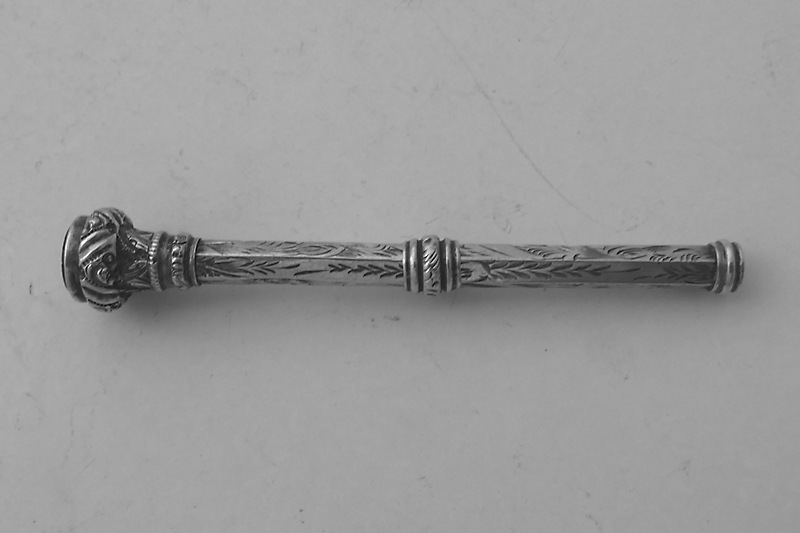
A George III penner made in Birmingham in 1806 by Joseph Wilmore. Price: £1100.00
|
9008 |
|
A George III silver-gilt filigree toy inkstand with an enamel base (7.7 cm from left to right and 2.5 cm high) , circa 1790. Price: £1,250.00
|
9798 |
|
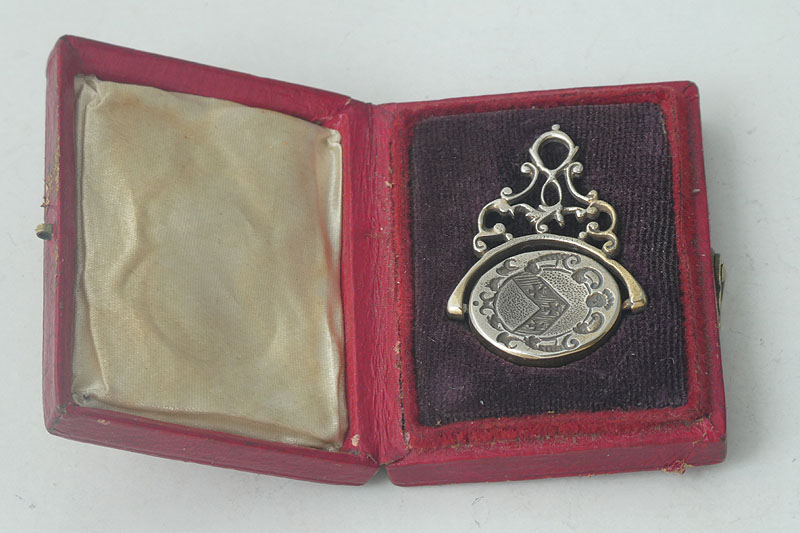
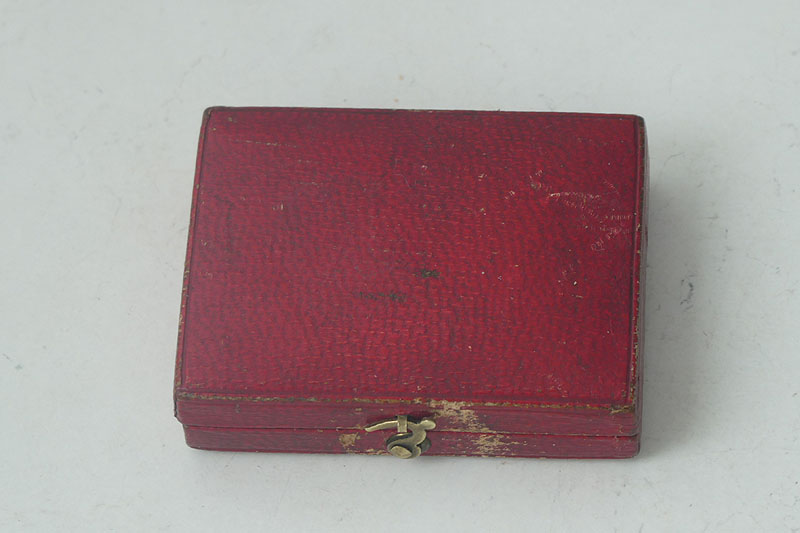
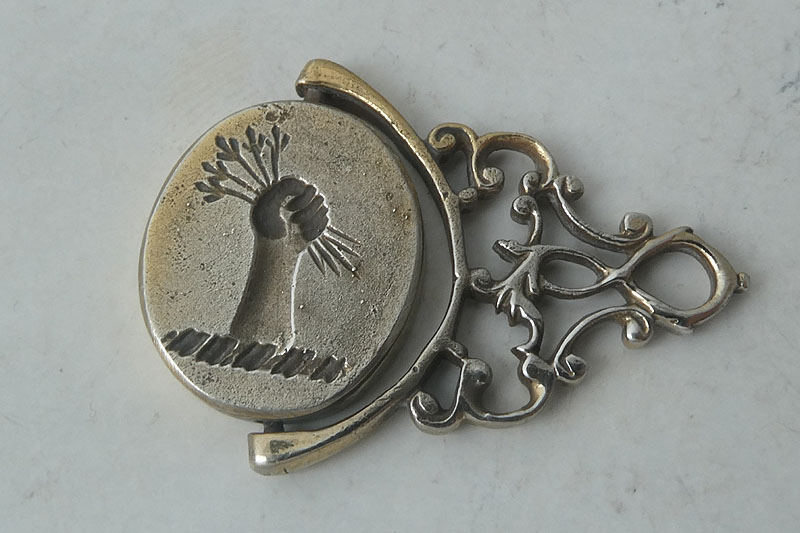
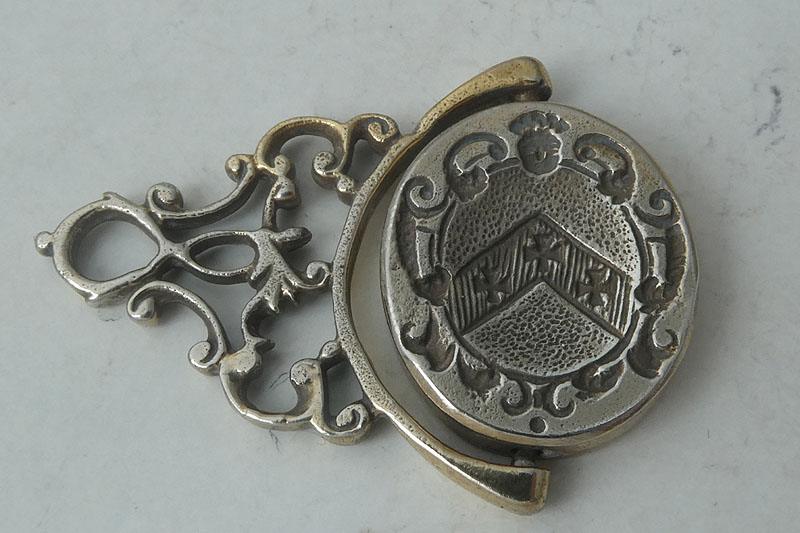
A George III revolving silver-gilt fob seal in early 19th century red leather case, unmarked circa 1770 engraved with the crest and arms of Peck. Price:
|
1154 |
|
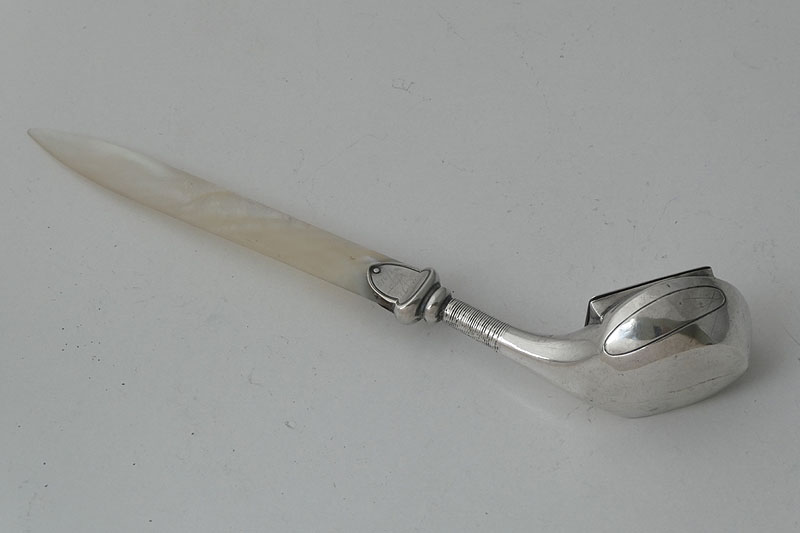
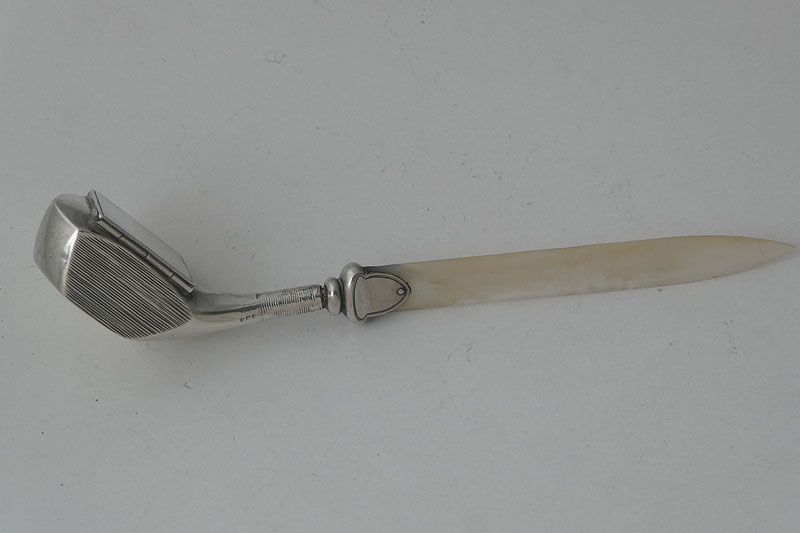
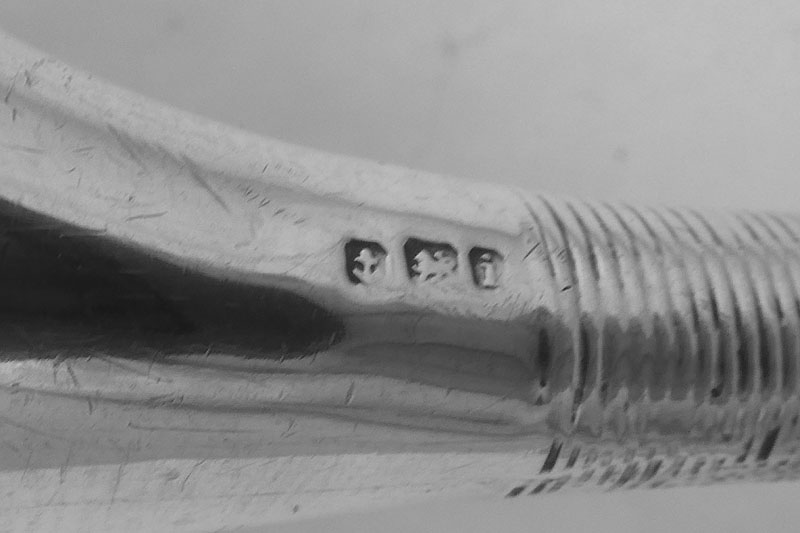
An Edward VII combined letter opener and stamp box modelled as a golf club made in Birmingham in 1908 by Crissford and Norris (part marked inside lid). Price: £795.00 An identical example to this was sold by Spinks of London as part of 'Blue Eyes' Collection of fine and rare Stamp Boxes on Wednesday 5th July 2009 as Lot 117 (hammer price £5,000). It was described by the cataloguer as 'One of the rarest novelty boxes extant.. a ...fine and extremeley rare [stamp box] being one of the rarest and most sought after of the novelty boxes which has been missing from most of the great collections to have come onto the market'.
|
1319 |
 |
A William IV glass inkwell with silver 'Berry's Patent' lid, by Henry Berry London 1832 . According to the available literature Berry is recorded as producing travelling inkwells with this mechanism as early as 1832, the date of this example. They were still being advertised in 1853. |
7909 |
 |
A gold pencil modelled as an umbrella with a pearl forming the handle, unmarked circa 1860 . Price: £385.00 |
6270 |
 |
A Victorian gold combined fountain pen and mechanical pencil with engraved body and unengraved hardstone matrix, unmarked circa 1870. Price: £345.00 |
8155 |
 |
A glass inkwell with silver mounts, by Thomas and James Phipps London 1817 . Price: £295.00 |
5949 |
|
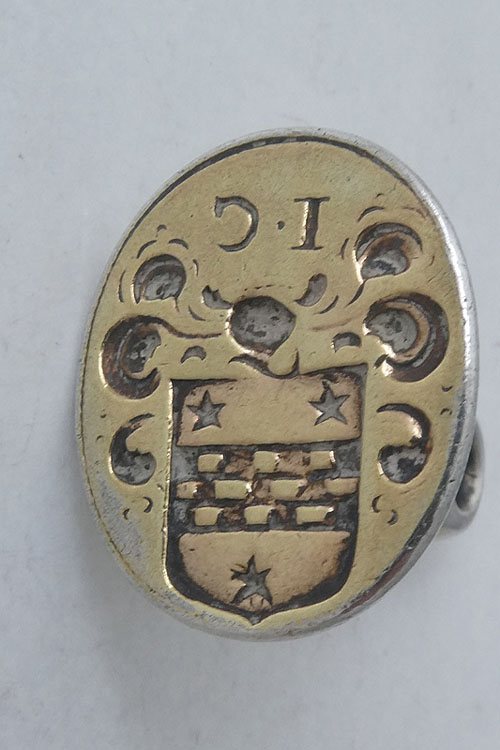
A Charles I silver-gilt fob seal engraved with an armorial and initialled {IC}. Price: The armorial is not apparent in the reference books but, in conjunction with the initials, appears to be a variant on Crickman or Chanirew (of Scotland).
|
1268 |
 |
A George III desk seal with a wooden handle and silver matrix, unmarked circa 1770, engraved with an armorial (Argent a lion rampant crowned within a bordure engrailed Azure) and crest (a demi-lion rampant out of a crest coronet)- these are apparently adopted. Price: £245.00
|
8750 |
|
A George V letter opener with cast scroll end and engraved ruler made in London in 1930 by Walter H. Wilson. Price: £245.00
|
9890 |
 |
A William IV glass ink well with silver top, London 1835 probably Thomas Diller (additionally marked with lion passant on the screw cap) . Price: £245.00 |
7113 |
 |
An Edward VII pen tray made in Sheffield in 1902 by Hawkesworth, Eyre and Company (retailed by George Birley and Company of Worcester), presented to Earl Beauchamp by the Teachers and Children of Callow End Schools for his marriage on July 26th 1902. William Lygon, 7th Earl Beauchamp (1872-1938) inherited the family title and estates in 1891. Following education at Eton College and Christ Church, Oxford (where he was President of the Oxford Union in 1893) Beauchamp served as Mayor of Worcester from 1895-1896. He then began a national political career involving the Governorship of New South Wales (1899-1902), being appointed a Privy Councillor and Captain of the Gentleman at Arms in 1906, Lord Steward from 1907-1910 and President of the Council in 1910. In 1902 Beauchamp married Lady Lettice Mary Elizabeth Grosvenor, daughter of the 1st Duke of Westminster, in 1902 (the event for which this pen tray was presented to him) but in 1931 it became publicly known that Beauchamp was homosexual and he went into self imposed exile on the continent. The departure of the Earl left his estates and houses occupied by his wife and six children. His second son, the Hon. Hugh Lygon, was a contemporary at Oxford of Evelyn Waugh and through their friendship Waugh often stayed at Madresfield, the Worcestershire estate of the Lygon family. Waugh based many of the situations and characters in Brideshead Revisited on the Lygon family (the Chapel at Madresfield is a clear inspiration for that at Brideshead).
|
8352 |
 |
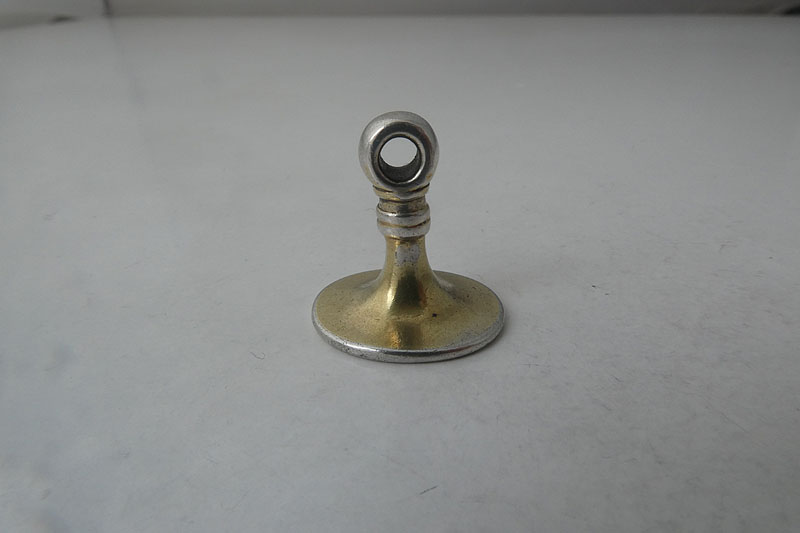
A hemi-spherical fob-seal with uncut stone decorated with leaves circa 1850. Price: £220.00 |
7500t |
 |
A George III porte-crayon with integral perpetual calendar, unmarked circa 1810.
|
7963z |
 |
An amethyst seal matrix circa 1760, engraved with an armorial (a modern seal impression is included). The arms appear to be a variant on those of Taddy quartering Alwyn or Alwin, Sheppard or Gyde and another. |
7726 |
 |
A George III fob seal made in London circa 1760 by R.G, initialled {T/J B} beneath an escallop (for a member of Barnaby, Barnard, Bidwell, Bottell, Bower, Bridesley or Brownell families).
|
8517 |
 |
A fob seal, circa 1760, engraved with an armorial. Price: £165.00 |
4713 |
 |
A George III fob seal ,c. 1780, unmarked, engraved with the arms of the Saxton family (with a slight variant on the crest). The arms on this seal are those of the Saxton family of Cheshire but the crest on it is 'Out of a ducal coronet a hind's head between 2 wings'. The crest of Saxton was 'Out of a ducal coronet a nag's head between 2 wings'. This difference can be ascribed to a mistake, either by the engraver or the owner, or to this seal having been used by another branch of the family who wanted to use this small alteration to make the arms and crest specific to them.
|
8244 |
 |
A late seventeenth/early eighteenth century small knife (perhaps a quill cutter) with a handle simulating shagreen and steel blade with cutler's mark, European. Price: £145.00 |
6932 |
 |
A letter opener, by Sampson Mordan and Company Chester 1906. Price: £110.00 |
5312 |
 |
A wax impression of a coat of arms in the original lignum vitae box, circa 1835, the arms and crest are those of Perrin . Price: £55.00 |
7727 |
 |
A pencil, unmarked circa 1900. Price: £20.00
|
9004 |