- Search Engine
- | About us
- | Index
- | History
- | The way we operate
- | Buying from us
- |
Our forthcoming Fairs - | Email us
- | Index of Research
- | Exchange Rates
- | Privacy & Security |
Medals, coins, counters, tokens and badges of office

Click on |
Description — clicking on underlined text brings up extra full size images of each piece |
Stock number |
 |
A silver medallion commemorating the marriage of Charles II and Catherine of Braganza, c.1662. Price: In 1662 Catherine of Braganza (1638-1705), daughter of King John IV of Portugal, arrived in England as the consort of the recently restored Charles II. As part of her dowry Great Britain gained Tangier and Bombay (along with trading concessions with Portugal and a sum of £300,000). She also appears to have been responsible for popularising tea drinking in her new home. When Charles II died in 1685 Catherine returned to Portugal and served as a key adviser to her brother Peter II, serving as Regent in 1701 and 1704-1705. Her name is recorded for posterity in the United States - the borough of Queens in New York was so named while she was Queen of England. |
7622 |
|
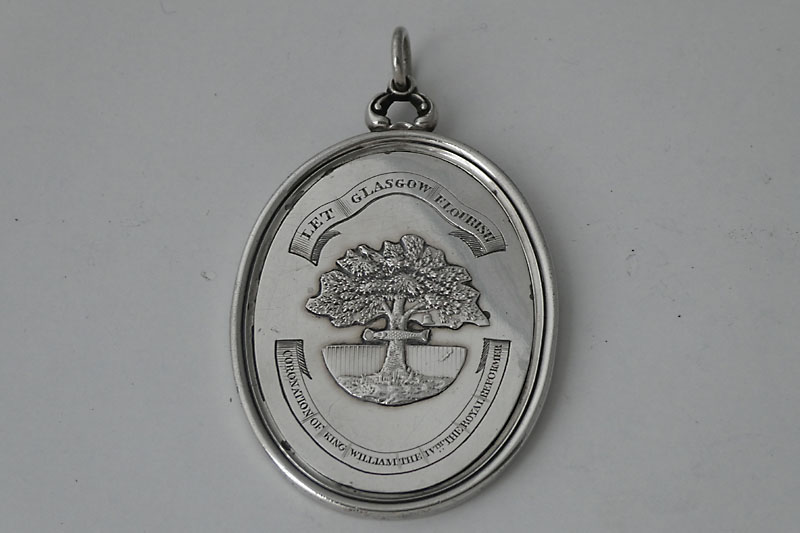
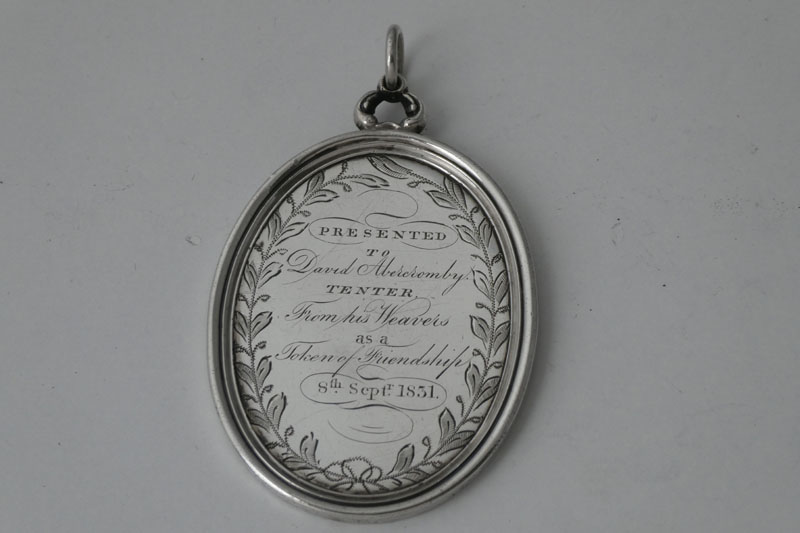
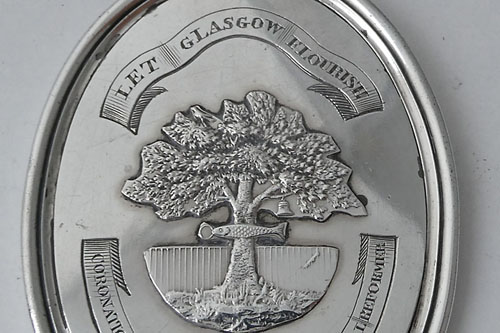
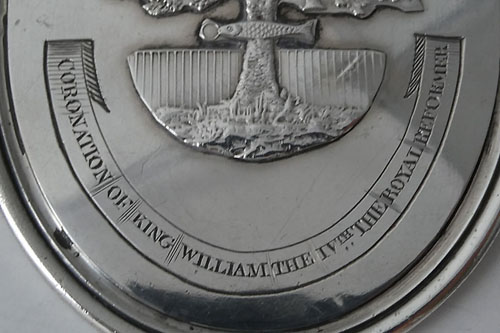
A William IV oval medal with the cast crest of the city of Glasgow commemorating the coronation of William IV the reverse engraved 'Presented to David Abercromby TENTER from his weavers as a token of friendship, 8th September 1831'. Price: £875.00 This medal commemorates the coronation of King William IV in 1831- he was believed, correctly, at the time to be more amenable to the reform movement in politics than George IV and would oversee the passing of the reform act of 1832. Political meetings held in Glasgow expressed concern at the ‘slow advance’ of the reintroduced reform bill, pointing to the ‘most injurious effect upon the mercantile interests of this community’, which would ‘continue to languish’ until the issue was settled. On 8th September the coronation was marked by another procession of the Glasgow trades, involving some 12,000 people carrying banners in favour of the king, reform, economy, peace and ‘no boroughmongers’, which the Scottish solicitor-general, Henry Cockburn, described as ‘a magnificent and gratifying yet fearful spectacle’. Great care was taken by the organizers and the authorities to ensure that the event was orderly. ‘Considerably upwards of 100,000’ marchers and spectators gathered on the Green and there was a ‘very grand display of fireworks’ in the evening. Following the passing of the Reform Act on 7th June 1832, the lead up to which had seen unrest in Glasgow, the parliamentary representation of the city was transferred from the Glasgow Burghs (with a more limited franchise) to Glasgow with a substantially larger electorate of 6,994. This seems to be the background to this medal and David Abercrombie, who sadly seems to have had no mentions in the newspapers of the time or available genealogical references, was clearly on the reforming side. Given the procession held on the day of the coronation it is reasonable to suggest that his workers were represented there.
|
9815 |
 |
A matched pair of medals - one silver the other base metal - by Thomas Pingo of London 1774, depicting Peter Muilman and his wife Mary and their home on the occasion of their fortieth wedding anniversary, and a print showing Kirby Hall, their home . Further details about these unusual medals may be found here |
4433 |
|
A George III gilt bronze medal, in its original case, for the Pitt Club of London inset with a Tassie portrait of William Pitt (d. 1806) circa 1808, engraved with the name of John Dodson Esq. CLD Price: The original London Pitt Club was founded in 1793 to counteract the ideas of the French Revolution and support the political beliefs of William Pitt the younger (1759-1806) who served as Prime Minister from 1783-1801 and 1804-1806. It remained a small society until the early 19th century and was relaunched in 1808 (when it was dissolved in 1849 1,731 members had been enrolled).
|
9265 |
|
A Victorian agricultural medal made in York in 1858 by Robert Heselgrave. Price: The Yorkshire Gazette of 4th August 1860 records that 'Mr. D. Rapp, Norton, Malton' had won a medal for 'Extra stock cattle... for a Hazel Cow'. The same report appeared on the same day in the York Herald and also appeared in Bell's Weekly Messenger on the 13th. The winner of this medal was David Rapp (c. 1831-1905). David Rapp was a butcher and there are references to his winning other agricultural prizes in 1860 but the Malton Gazette of 1st April 1865 records his bankruptcy, however by 1871 he had returned to his former trade and is recorded as a butcher in Wood Street in the census. He is still there in 1881 and 1891. This medal is particularly interesting as it carries the maker's mark of Robert Heselgrave. As noted by Martin Gubbins in 1983, when Silburn Barber, son of the goldsmith James Barber, sold the business that had been started in Coney Street in York as early as 1770 by Hampston and Prince, in September 1859. At this point it was taken over by two former employees of the firm- Heselgrave and Walker. However this partnership was shortlived as Robert Heselgrave advertised on his own by December 1859. Very few hallmarked pieces with the RH maker's mark attributed to Robert Heselgrave have apparently been noted- it has been suggested that the low quantities of silver assayed in York in the final years of the assay office mean that date letters were not necessarily changed as efficiently as had previously been the case.
|
9947 |
|
A Victorian medal issued by the Yorkshire Agricultural Society as the second prize for Extra Stock Pigs [in] 1850 to Fergus Ferguson [of] Walkington, Beverley made in York in 1850 by James Barber. Price: £425.00 The Leeds Intellegencer of 10th August 1850 records that 'Four of the Society's first class, and four of their second class silver medals were given for extra stock deemed by the Judges worthy of their special commendation.... [including] a boar (small breed), birth Oct. 2, 1849- Fergus Ferguson [of] Walkington'. The same report appeared on the same day in the Yorkshire Gazette, the Farmer's Friend and Freeman's Journal and in Bell's Weekly Messenger two days later. Fergus Ferguson (1821-1901), who was born and died at Walkington, was the son of Daniel Ferguson and his wife Margaret. Daniel was Rector of Walkington and a Justice of the Peace (members of the Ferguson family occupied the rectory for almost the whole of the 19th century). Fergus is recorded in the 1851 census as the fourth of five sons born to the couple and in the 1861 census as 'a farmer with 360 acres employing 13 men and 3 boys'. In 1871 he was unmarried living in Risby, Yorkshire, farming '190 acres and employing 1 man and 1 boy' and by 1881 was 'a retired farmer' but as married to Jane Ferguson. The records show that Fergus Ferguson married Jane Stubbs in York on the 29th of October 1878. In the 1891 census both Fergus and Jane are recorded in Bessingby. The same is true in 1901 but the couple are again at Walkington. Ferguson died on 19th September 1901 and the records show him leaving an estate of £160 18s 10d but to Annie Reaston Spinster (there is no apparent record of the death of Jane Ferguson).
|
9947 |
|
A George V Colonial Auxiliary Forces medal with George V cypher in its original case made with Garrard imprint in London in 1929 by Sebastian Garrard. Price: £425.00 The Colonial Auxiliary Forces medal was instituted in 1899 for part time members of the organised British forces in the colonies (except India). It could be issued to officers with 20 years experience and carried the post nominal abbreviation of VD (for Volunteer Decoration). In 1930 the decoration was replaced by the Efficiency Decoration to standardise recognition across the Empire.
|
9893 |
|
A Charles I medallion commemorating the marriage of the King and Henrietta Maria of France, 1625. Price: Charles I inherited the British crown from his father in 1625, his elder brother Prince Henry having died in 1611. Later that year the King married Henriette Marie of France, daughter of Henry IV and sister of Louis XIII of France. She came over to Britain and was officially known by the more anglicised Queen Mary- however she did not like this and was more usually referred to as Henrietta Maria. As a Roman Catholic she was often unpopular in 17th century Britain and became a reviled figure during the Civil Wars and there was an attempt to have her legally arrested in 1641, in order to put pressure on the King. During the Civil War she went abroad to raise money and support for her husband (and after his deposition and subsequent execution in 1649, for her eldest son). Following the Restoration of the monarchy in 1660 Henrietta Maria returned to London and stayed until 1662 before returning to France. An example of this medallion was described in a letter written by Rev. Joseph Mead to Sir Martin Stuteville on 28th May 1625. He records that these medallions were scattered among the crowd at the wedding, noting that: "I have one of the pieces flung about at the marriage. On one side is Cupid, holding in one hand lilies, in the other roses; the motto Fundit amor Lilia mixta rosis. On the other side. The picture of the King and Queen with this- Carolus Mag Et Henrietta Maria, Brit. Rex et Reg. No jollity at the marriage, not any of the French, save the King himself and the prince in gay clothes. But our ambassadors were very rich and gallant."
|
9223 |
|
An Edward VII silver prize oar made in London in 1903 by Charles Edwards. It was won by B. F. Sawbridge of University College, Oxford for rowing in the second seat in the Junior Fours Competition in 1903 and is in the original leather case (with the retailer's mark of R. S. Rowell of 115 High Street, Oxford). Accompanying the oar is Sawbridge's Book of Common Prayer presented to him by his Godmother I[sabella] T[udor] Frere in 1898 (she was also his maternal aunt) . Price: Bartle Frere Sawbridge (1884-1964) was the second son of Reverend John Sikes Sawbridge (1841-1925) and Elizabeth Tudor Frere (1850-1931), daughter of noted botanist George Edward Frere and niece of Sir Henry Bartle Frere, 1st Baronet. In 1893 the Bury Free Press reported on a dramatic performance put on by the younger members of the Sawbridge family in which Bartle played "David Copperfield and the waiter". Bartle Frere was educated at Winchester College and matriculated at New College, Oxford in 1902 to read chemistry. As this oar testifies Frere was a noted rower at Oxford and was also in the crew of the Second Torpid boat in 1904. In 1905 Sawbridge was mentioned in the Globe newspaper as having shot a 23lb grouse (possibly an escapee from Sandringham). After Graduation Frere worked as an assistant to A. C. Chapman, a noted authority on the chemistry of brewing, and was thanked personally for 'preparing some of the photomicrographs' to be included in Chapman's 1912 work 'Brewing' (published by Cambridge University Press). He had been admitted to the Royal Society of Chemistry in 1908 and made a Fellow in 1911. During the First World War Frere joined the London Rifle Brigade and emerged with the rank of Captain, having been involved with the anti-gas preparations in France. In 1927 Bartle married Katherine Frances Iles (1891-1943). In civilian life Frere joined the brewers Whitbread and Company and retired in 1947, by which time he was senior chemist at their Chiswell Street brewery. 1947 also saw Sawbridge's second marriage to Miss. S. B. Mills who survived her husband by 13 years, dying in 1976.
|
9154 |
 |
An engraved school medal, by Fergusson and McBean of Inverness, awarded by the London Inverness-shire Association to Catherine Taylor Dux of Inverness High Public School in 1903. |
7216 |
 |
A gaming token depicting Frederick, Elector Palatine of the Rhine (1596-1632) made in London circa 1620 by Simon Van De Pass. Frederick, Elector Palatine (1596-1632) inherited the family lands of the Palatinate of the Rhine in 1610 and married Princess Elizabeth, daughter of James I of England, in 1613. Frederick was a prominent member of the Protestant party in the predominantly Catholic Holy Roman Empire ruled by the Habsburgs and in 1619 accepted the Crown of Bohemia in the Protestant interest. Sadly the Catholic claimant to the throne, and head of the Habsburg family, was elected Holy Roman Emperor in 1619 (with Frederick's being the only vote against him). The fighting that these events caused was one of the immediate sparks that caused what became known as the Thirty Years War. Frederick held Bohemia for two years before losing control of it and all his ancestral lands. He died in 1632. This token was produced by noted engraver Crispin Van De Pass (1564-1637) in London in the early 1620s when, due to his being the son-in-law of the King and his Protestantism, Frederick was a popular figure. His son Prince Rupert went on to be the most charismatic Royalist cavalry commander of the British Civil Wars.
|
8362 |
|
A Queen Anne silver coronation medal, 1702. Price: £225.00
|
9487 |
|
A James II silver 'Seven Bishops' medal, c. 1688 Price: £225.00 The case of the Seven Bishops was one of the causes Celebres of late 17th century England. In 1687 James II, a Catholic sovereign of a Protestant nation, passed a Declaration of Indulgence suspending many of the penal laws supporting the Church of England (including those enforcing attendance and those banning non members of the Church of England from holding office). In April 1688 The King ordered the senior members of the Church of England, the Archbishop and Bishops, to have this proclaimed from the pulpits of the churches under their jurisdiction but this was met with a refusal. The King then ordered the Bishops to come to him to answer for their refusal. When the Bishops arrived at Court on 8th June they had a large public following but when they met the King he had them arrested and sent to the Tower of London, despite many senior figures offering to guarantee their bail. The case came before the judges, ostensibly loyal to the King, on 29th June but the jury found the Bishops not guilty. The birth of James II's son by his second wife, the Catholic Mary of Modena, on 10th June lead to the threat of a Catholic Succession (he superceded his two half sisters, the Protestants Mary and Anne who had been the heirs up until this point). The combination of the two events was enough to cause the conflict that ended in James's flight from Br itain (he died in exile in 1701) and he was effectively succeeded by his daughters while the the Prince of Wales went on to be the "Old Pretender" and founded the Jacobite line of succession.
|
9486 |
 |
A George III Proof halfpenny produced by Matthew Boulton at his Soho works in 1799. The earliest halfpenny seems to have been produced in the early 13th century and the denomination was only abandoned on the change to decimal coinage in 1971. By the 18th century the shortage of small change was giving the country significant cause for concern. Allegedly by 1780, only 8% of copper coins in circulation were genuine. To combat counterfeiting in 1797 The Royal Mint contracted Matthew Boulton to produce copper coinage in Birmingham. |
8191 |
 |
A George III silver medal commemorating the entry of the British army into Paris in July 1815. The obverse carries the profile of the Duke of Wellington and the reverse a view of the Louvre Palace. Price: £210.00 Following the capture of Paris by British and allied troops and the abdication of Napoleon in 1814 the Emperor was exiled to Elba. However he escaped in February 1815 and regained control of France. This necessitated a new coalition to be formed against him comprising, among others, Austria, Russia, Prussia, Holland, Hanover and Great Britain. The commander of the British forces was Arthur Wellesley, who had been created 1st Duke of Wellington in 1814. |
8883 |
 |
A William III copper medal commemorating the death of Mary II, circa 1694 . When James II fled England in 1688, he was taken to have abdicated his throne. His eldest daughter and his son-in-law and nephew, William, Prince of Orange, became joint monarchs as Mary II and William III. Mary died of smallpox in 1694 and William ruled alone until his death in 1702 when he was succeeded by Mary's younger sister Anne. |
6890 |
|
A Victorian school medal cast with the arms of Eton College issued for the House Fours competition in 1872 to E. H. Pares. Price: £175.00 Edward Henry Pares (1854-1931), a descendant of Edward III, was educated at Eton College and then Emmanuel College, Cambridge (although there is no evidence that he graduated). He joined the Leicestershire Yeomanry Cavalry in 1876 (reaching the rank of Captain in that regiment in 1886). In 1878 Pares inherited Hopwell Hall, Derbyshire and in 1879 he married Muriel Lily Webster (1860-1927) but the couple were divorced in 1895 (with Muriel retaining custody of their 2 sons and three daughters due to Pares actions). Pares was a Justice of the Peace and served as High Sherriff of Derbyshire in 1885. In 1896 Pares remarried to Agnes Heard (1870-1931) and both are buried in Moggerhanger, Bedfordshire.
|
9792 |
 |
A Victorian silver agricultural medal, in the original red morocco leather case, issued by the Highland and Agricultural Society to Ja[me]s McPherson of Pitcroy for the best Golden Melon Barley exhibited at Aberlour in 1868. Price: £160.00 According to the records of the Highland and Agricultural Society in 1868 the competition for the production of Golden Melon Barley (used in Whisky production) had 3 entries. James McPherson of Pitcroy won having sowed his land (which was 50 feet above sea level and exposed to a South East wind) on April 27th 1867 and reaped it on July 20th. He succeeded in growing 5 1/4 quarters per Imperial Acre and each bushel weighed 57 lbs. |
8876 |
|
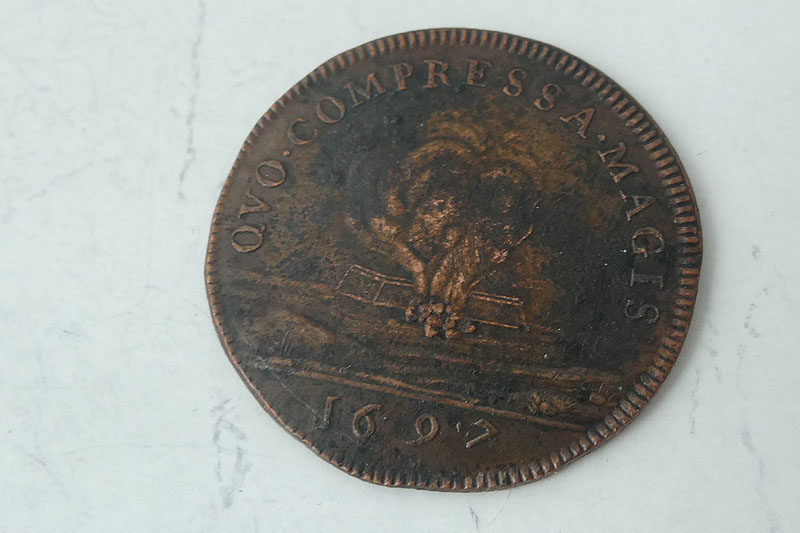
A James II medal depicting James III (as Prince of Wales) on one side and an exploding mine made in 1697 by Norbert Roettier. Price: £150.00 The Treaty of Ryswick was signed in 1697 by Louis XIV and the international powers (including William III representing Holland and Great Britain) who had been opposing him since 1688. It served as a temporary truce that was broken by the war of the Spanish Succession in 1700. The treaty contained many clauses but the most important to King James II of England, living in exile in France, was that Louis XIV (who had been both housing and financially supporting the King and his Jacobite supporters) agreed that William III was legitimate King of England in place of James. It also meant the exiled King leaving French territory. The Jacobites issued a number of medals at this point to promote the cause and chose to illustrate not James II but his son James Francis Edward Stuart, Prince of Wales later, from different political standpoints, known as James III or 'The Old Pretender'.
|
1352 |
|
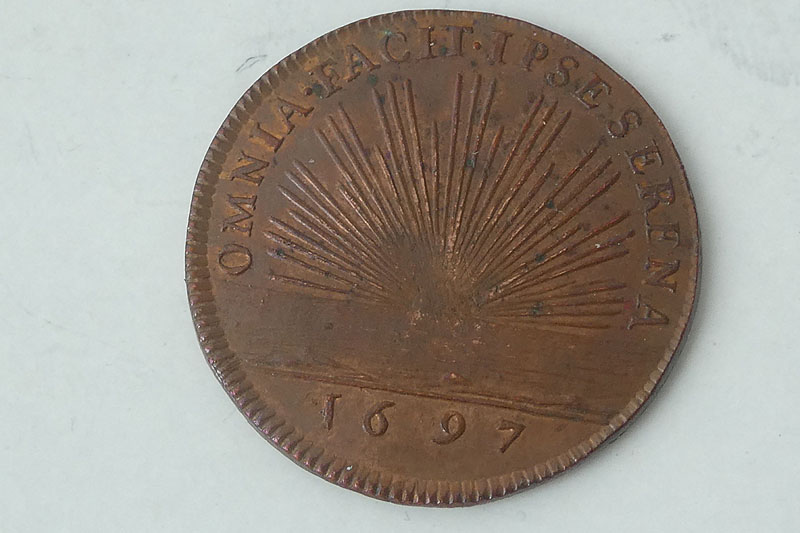
A James II medal depicting James III (as Prince of Wales) on one side and a rising sun on the other produced in 1697 by Norbert Roettier. Price: £150.00 The Treaty of Ryswick was signed in 1697 by Louis XIV and the international powers (including William III representing Holland and Great Britain) who had been opposing him since 1688. It served as a temporary truce that was broken by the war of the Spanish Succession in 1700. The treaty contained many clauses but the most important to King James II of England, living in exile in France, was that Louis XIV (who had been both housing and financially supporting the King and his Jacobite supporters) agreed that William III was legitimate King of England in place of James. It also meant the exiled King leaving French territory. The Jacobites issued a number of medals at this point to promote the cause and chose to illustrate not James II but his son James Francis Edward Stuart, Prince of Wales later, from different political standpoints, known as James III or 'The Old Pretender'.
|
1350 |
|
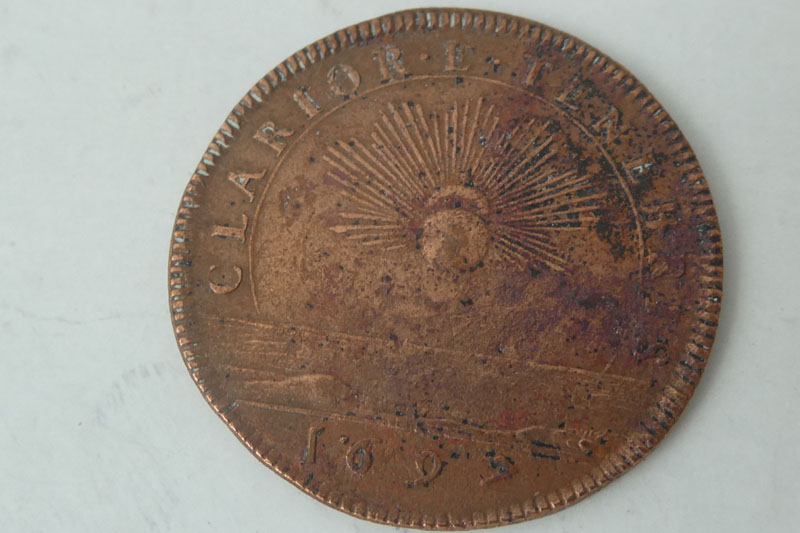
A James II medal depicting James III (as Prince of Wales) on one side and a sun in partial eclipse on the other produced in 1697 by Norbert Roettier. Price: £150.00 The Treaty of Ryswick was signed in 1697 by Louis XIV and the international powers (including William III representing Holland and Great Britain) who had been opposing him since 1688. It served as a temporary truce that was broken by the war of the Spanish Succession in 1700. The treaty contained many clauses but the most important to King James II of England, living in exile in France, was that Louis XIV (who had been both housing and financially supporting the King and his Jacobite supporters) agreed that William III was legitimate King of England in place of James. It also meant the exiled King leaving French territory. The Jacobites issued a number of medals at this point to promote the cause and chose to illustrate not James II but his son James Francis Edward Stuart, Prince of Wales later, from different political standpoints, known as James III or 'The Old Pretender'.
|
1349 |
 |
A George III 1 shilling trade token issued by John Robertson of Newcastle, Goldsmith, in 1811. Price: £120.00 Obverse: Arms, three castles, two over one, gules, and supporters of Newcastle; Motto, FORTITER DEFENDIT TRIUMPHANS (Triumphing it bravely defends). Crest, a lion holding a standard issuant from a castle; PAYABLE BY IOHN ROBERTSON. NEWCASTLE UPON TYNE. Reverse: Female seated on a bale, with spear and cornucopia; a ship in the distance; NORTHUMBERLAND & DURHAM 12_D TOKEN 1811. The spear is between the N and the D. A border of dots on the obverse. These tokens were issued in many locations throughout the country at a time when Great Britain was short of silver coinage. Robertson's tokens ended up being the subject of a correspondence in the local newspapers. On 26th November 1811 local traders (118 of them) refused to accept Robertson's tokens or anyone else's. On 1st May 1812 Robertson promised to honour the stated value of the tokens and although 'no two of John Robertson's Tokens are of the same weight, but any twenty of them, taken promiscuously, will average in real value from 10d. to 10 1/2 d. each' (the alleged value was 8d. to 8 1/2d. each). The London Gazette records that Robertson was declared bankrupt , Feb. 20, 1821. Reference: Dalton Northumberland- Newcastle upon Tyne 11
|
8949 |
 |
A George III sixpence trade token, issued by Cattle and Barber of York, Goldsmiths, in 1811. Obverse: Arms of the city between olive and palm branches. Legend, YORK 1811. There are four berries in the olive branch. The stem of the palm is over the first one in the date. NOTES: Cattle and Barber were goldsmiths and jewellers in Coney Street, York. “An issue of silver tokens has been made by Messrs. Cattle and Barber of York. These tokens are of the value of Shillings and Sixpences, and are finished in a neat style, bearing on one side the arms of York, and on the other, their value, with the names of the issuers.”- Chronicle, Oct. 12, 1811.
|
8948 |
|
A George V medal issued by Dobbie & Co. Royal Seed Growers and Florists with unengraved reverse, made in Birmingham in 1936 by Sydney Latimer and in original case (carrying Latimer's retail stamp). Price: £110.00 Dobbie & Company were founded in Renfrew by James Dobbie in 1865 and quickly received a Royal Warrant as Gardeners and Nurserymen to the Royal Household. They expanded into the supply of seeds through their catalogues and built up a customer base of over 50,000 in the next century. In 1969 the company expanded outside Scotland and diversified into running garden centres (in addition to their seed catalogue). In 2007 a majority stake was purchased by Tesco and by 2008 they had purchased all the shares in the company. In 2016 Dobbie's was sold again to Midlothian Capital Partners and Hattington Capital and in 2022 expanded to include premises in Northern Ireland. Sadly in 2024 seventeen garden centres were closed.
|
9876 |
 |
A Victorian base metal medal commemorating the opening of the Alton Loan and Art Exhibition on 23rd June 1882 by the Duke and Duchess of Connaught. This medal was made by a Mr. Lewis (probably William Osborne Lewis of Birmingham) on behalf of W. Row & Son of Alton. Price: The Hampshire newspapers of the summer of 1882 make several references to the forthcoming
‘Clearance Sale of Medals … W. T. Row [and] Son beg to give notice they intend, offering the |
8963 |
 |
A silver sixpence in superb condition, 1834. |
5193 |
 |
A George III 1 shilling trade token issued by John Robertson of Newcastle, Goldsmith, in 1811. Price: Obverse: Arms, three castles, two over one, gules, and supporters of Newcastle; Motto, FORTITER DEFENDIT TRIUMPHANS (Triumphing it bravely defends). Crest, a lion holding a standard issuant from a castle; PAYABLE BY IOHN ROBERTSON. NEWCASTLE UPON TYNE. Reverse: Female seated on a bale, with spear and cornucopia; a ship in the distance; NORTHUMBERLAND & DURHAM 12_D TOKEN 1811. The spear is between the N and the D. A border of dots on the obverse. These tokens were issued in many locations throughout the country at a time when Great Britain was short of silver coinage. Robertson's tokens ended up being the subject of a correspondence in the local newspapers. On 26th November 1811 local traders (118 of them) refused to accept Robertson's tokens or anyone else's. On 1st May 1812 Robertson promised to honour the stated value of the tokens and although 'no two of John Robertson's Tokens are of the same weight, but any twenty of them, taken promiscuously, will average in real value from 10d. to 10 1/2 d. each' (the alleged value was 8d. to 8 1/2d. each). The London Gazette records that Robertson was declared bankrupt , Feb. 20, 1821. Reference: Dalton Northumberland- Newcastle upon Tyne 11
|
8757 |
 |
A plain counter engraved 'Fear God' and on the reverse, 'WC Morpeth June 14th 1798'; unmarked. Price:  |
8571 |
 |
A Jernegan medal with on front an image of Queen Caroline 'GROWING ARTS ADORN EMPIRE - CAROLINE PROTECTING' and on obverse 'BOTH HANDS FILLd FOR BRITAIN - GEORGE REIGNING' 1736. Arguably the most important piece of eighteenth century silver in the Hermitage Museum in St. Petersburg is the 'Jernengan Wine Cistern' made in around 1735 by Frederick Kandler (of which there are copies in the Victoria and Albert and the Metropolitan Museums). This monumental piece of silver was commissioned by Littleton Poyntz Meynell from Henry Jernengan but when it was completed he did not accept it and in due course it was disposed of via a lottery (the smaller prizes being medals and the first prize, the cistern). The cistern was won by a Major William Battine, who had bought 7 tickets and also won six medals. He had sold the cistern to Empress Elizabeth of Russia by 1740. |
3832 |
|
An Edward VII medallion with a stylised version of the main element of the coat of arms of the City of Derby on the front for the Derby Bread Competition. It was issued to Wragg and Hamblin in 1911 and was made in London in 1910 by Elkington and Company. Price: £75.00 Wragg and Hamblin were prominent Bakers and Provisioners based in Allanton, Derbyshire in the first quarter of the 20th century. The founders were Isaac Wragg (1849-1906) and Harry Lionel Hamblin (1874-1961) who had married Wragg’s daughter Mary Jane (1874-1946) in 1898.
|
9615 |
 |
A Henry III silver penny circa 1250. Price: £75.00 |
3920 |
 |
A copper advertising token for Low's Grand Hotel, Covent Garden by John Kirk London 1774 In 1773 a 55 year lease on 43 King Street, Covent Garden was taken out in 1773 by David Low at £200 per year. The house, formerly the residence of the Edward Russell, Earl of Orford, appears in a 1738 image by William Hogarth. Low, formerly a peruke maker in Covent Garden, opened the house as Low's Grand Hotel in 1774 with a top price of 15s a night for a suite of two rooms (7 days wages for a skilled tradesman). The hotel was described as 'the only Hotel for Families on your Grace's estate . . . being fitted up in a Stile of Elegance for the reception of the Nobility and Gentry requiring temporary residence in Town'. Unfortunately these improvements came at a cost (£6000 or £7000 at Low's estimation) and Low became bankrupt in 1786. The property continued in mixed occupation with part of it serving as the first headquarters of the Royal Institute of British Architects from 1835-1837 and in the 1840s another part was a hotel run by actor and singer W. C. Evans. From the 1870s the building housed a number of clubs: from 1874-1875 the Savage Club, from 1882-1883 John Hollingshead's Falstaff Club, from 1884-1890 the New Club and 1891-1929 the National Sporting Club. It is now the London flagship store of clothing retailer L. K. Bennett.
|
8160 |
 |
A base metal medal made in 1829 depicting the copy of the Warwick vase created by Sir Edward Thomason in 1820. The original Warwick vase was discovered in Italy in 1770 and its form was often copied for use in silver objects. In 1820, Sir Edward Thomason, a leading Birmingham goldsmith and manufacturer, created a large scale copy (commemorated in this medal) which was acquired by the University of Cambridge in 1842 and still stands on the Senate House Lawn there. |
3385 |
|
A George VI silver cap badge for an Air Raid Precautions Warden made in London in 1939 by JC (unidentified). Price: £45.00 In September 1935 Stanley Baldwin (Prime Minister from 1923 to 1924, 1924 to 1929 and 1935 to 1937), published a circular entitled Air Raid Precautions (ARP) inviting local authorities to make plans to protect their people in the event of war. Such plans included building public air raid shelters. In April 1937 the government decided to create an Air Raid Wardens' Service and during the next year recruited around 200,000 volunteers. These volunteers were known as Air Raid Precaution Wardens. The main purposes of ARP Wardens were to patrol the streets during the blackout, to ensure that no light was visible, to report the extent of bomb damage and assess the local need for help from the emergency and rescue services. They were also responsible for the handing out of gas masks and pre-fabricated air-raid shelters (such as Anderson shelters or Morrison shelters), and staffed and organised public air-raid shelters. They used their knowledge of their local areas to help find and reunite family members who had been separated in the rush to find shelter during bombing raids. During the war there were over 1 million wardens, all volunteers. The vast majority of ARP badges are silver plated or base metal rather than silver.
|
9224 |
 |
A George IV bronze portrait medal of 'Francis Henry Egerton Earl of Bridgewater', by Donadio circa 1823. This medal was struck to commemorate the accession to the Earldom of Bridgewater of Francis Henry Egerton (1756-1829) as 8th Earl of Bridgewater in 1823. The 7th Earl, Egerton's elder brother John William had inherited the Bridgewater Estates, from their cousin, the 6th Earl, a noted great builder of canals in the late eighteenth century died without a male heir in 1803. Francis Henry Egerton died childless in 1829 and bequeathed his valuable 'Egerton Collection' of manuscripts relating to French and Italian literature to the British Museum along with £12,000 to fund further purchases. He also left £8,000 to the Royal Society to fund 'the best work on the Goodness of God as manifested in the creation' (the outcome is now known as The Bridgewater Treatises). Egerton was a notable eccentric: at his residence in Paris his many cats and dogs were dressed as Ladies and Gentlemen, taken out in his carriage, fed at his table and censured if their behaviour was not suitable. |
7084 |
 |
An oval school medal in base metal, for Acton County School showing the arms as 3 scimitars beneath a coronet and the motto PACTUM SERVA, circa 1920. Price: £35.00 |
1768 |
 |
A silver-gilt and enamel Treasurer's badge for the Royal Antediluvian Order of Buffaloes, by L. Simpson & Co, London 1925 inscribed on reverse: PRESENTED TO BRO J. LINTON (Host) FOR SERVICES RENDERED AS TREASURER. 23rd Sept 1925. Price: £28.00 |
2167 |
 |
A base metal medallion comemorating the 1862 International Exhibition . Price: £25.00 |
3386 |






![resented to him by his Godmother I[sabella] T[udor] Frere in 1898 (she was also his maternal aunt)](images/9154book3.jpg)


![Ja[me]s McPherson of Pitcroy for the best Golden Melon Barley exhibited at Aberlour in 1868](images/8876imed.jpg)