- Search Engine
- | About us
- | Index
- | History
- | The way we operate
- | Buying from us
- |
Our forthcoming Fairs - | Email us
- | Index of Research
- | Exchange Rates
- | Privacy & Security |
Caddy spoons, jam, honey and sugar spoons and shovels

Click on |
Description — clicking on underlined text brings up extra full size images of each piece |
Stock number |
 |
A caddyspoon modelled as a hand (with simulated engraved fingernails), by Josiah Snatt London 1807 . Price: £595.00 |
9640 |
 |
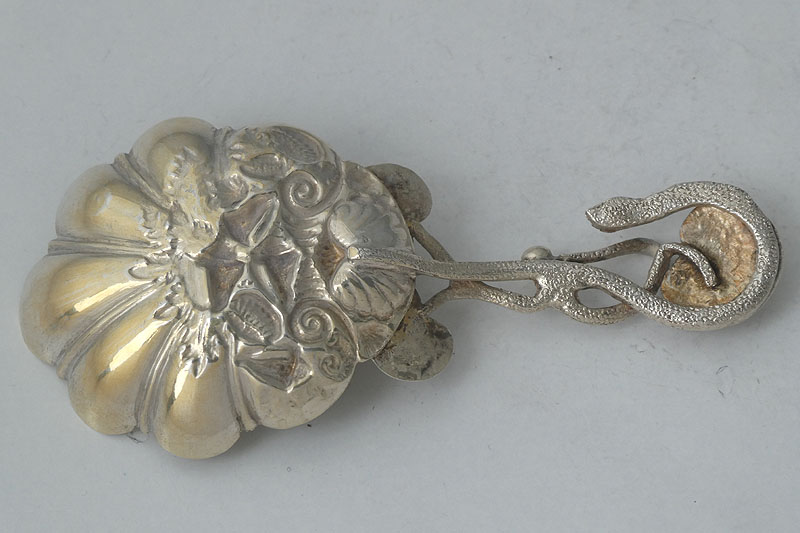
A cast Victorian caddyspoon with naturalistic stem, by George Adams London probably 1854 crested with a demi-griffin. A caddyspoon of the same model by the same maker but hallmarked in 1851 appears as plate 26d of John Norie's Caddyspoons- an illustrated Guide (1988) |
7418 |
|
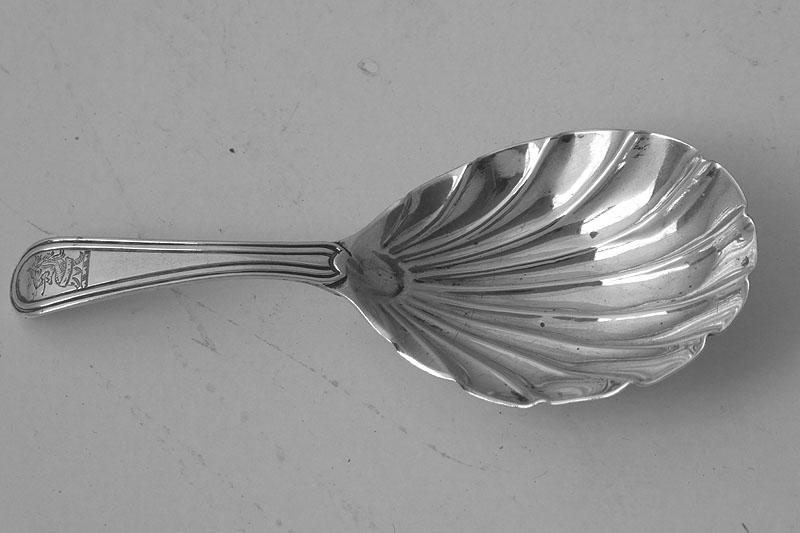
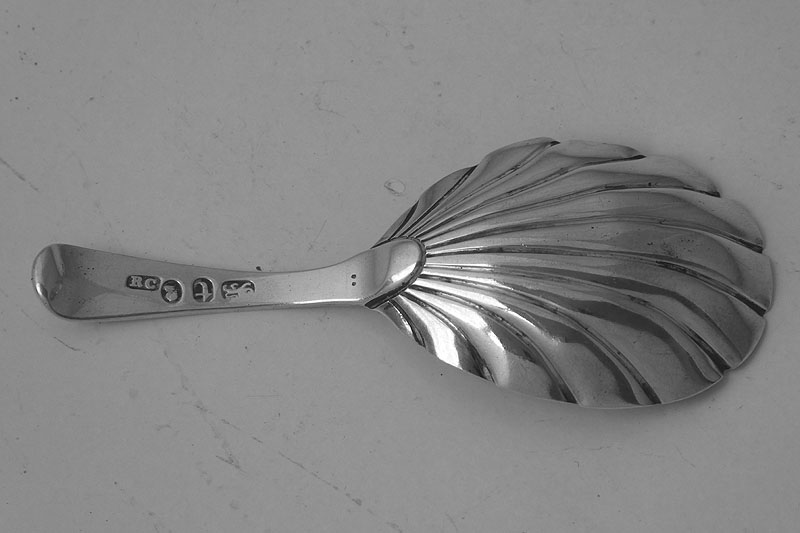
A George III Onslow pattern caddyspoon with fluted bowl unmarked circa 1770 (probably made by the Callard workshop), engraved with the crest, motto and monogram of a member of the Gode family of London Price: The bowl of this caddyspoon bears a strong resemblance to flatware produced by the Callard family of London spoon makers. The heel is very similar to the drop on the back of a soup ladle assayed in London by Christopher Fly Woods, Paul Callard's apprentice and son-in-law. Provenance: J. D. Norie (this spoon formed lot 402 of Part II of the collection sold at Woolley and Wallis on 28th July 2004).
|
9263 |
|
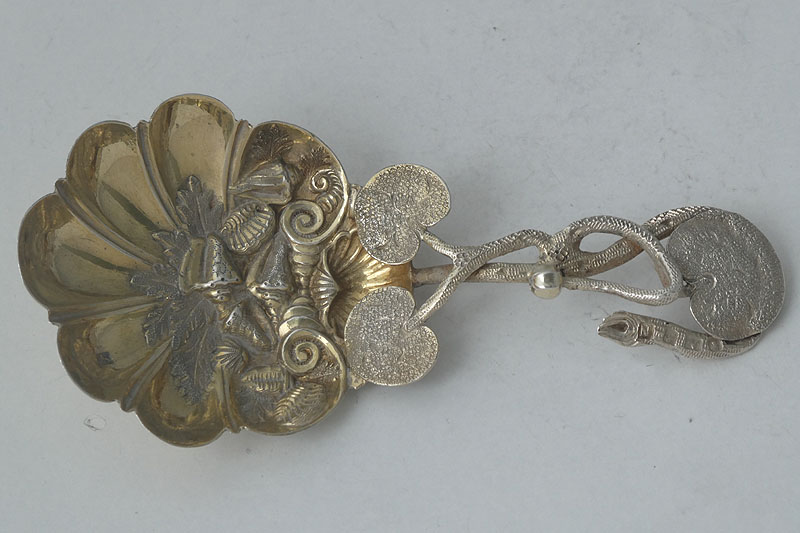
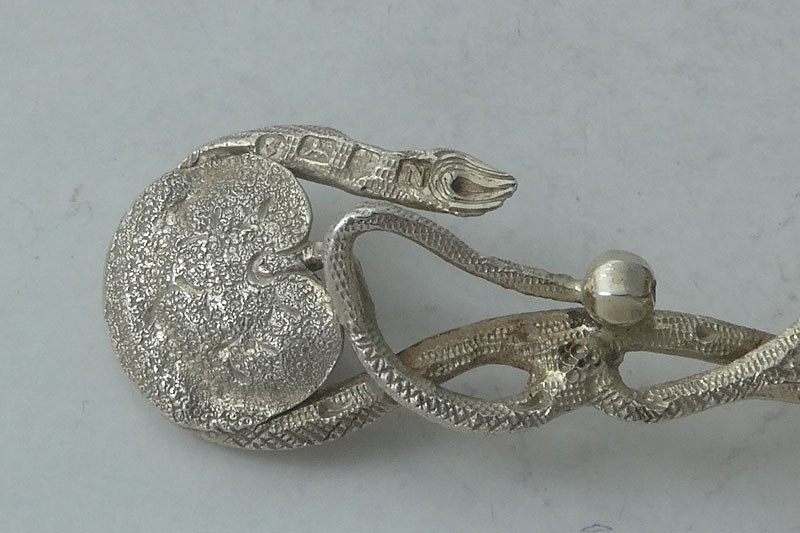
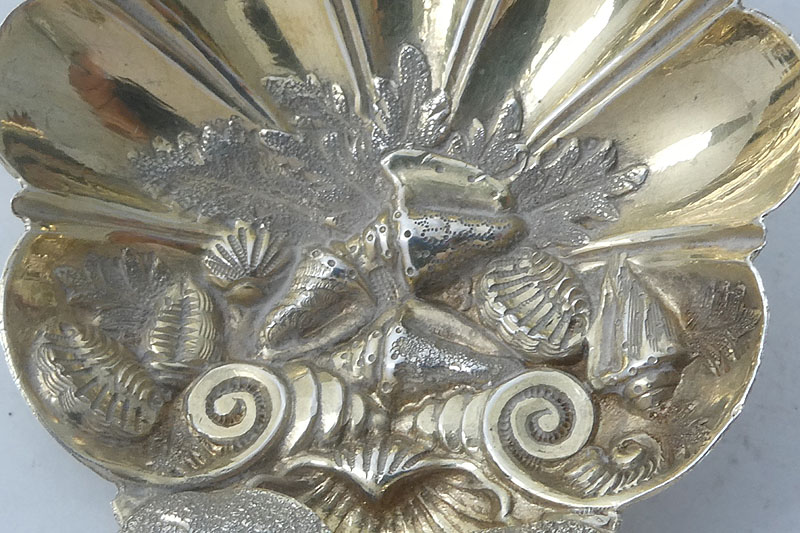
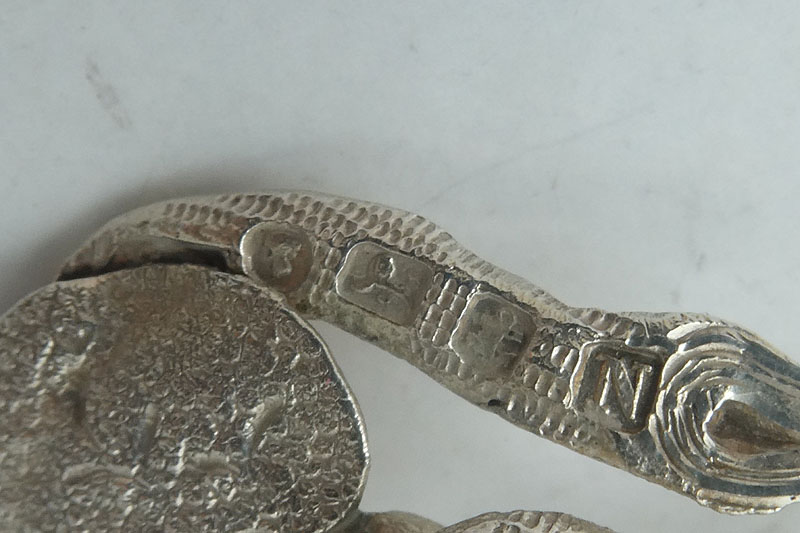
A Victorian parcel-gilt caddyspoon with naturalistic stem and impressed shells in the bowl made in Birmingham in 1862 (probably by Hilliard and Thomasson). Price: Although this spoon does not seem to have been struck with a maker's mark it is identical to one shown on plate 57 by this maker in John Norie's Caddyspoons- an illustrated Guide (1988).
|
1176 |
|
A William I caddy spoon with trifurcated handle made in Schoonhoven in 1843, engraved L. Alma-Tadema Price: Lawrence Alma-Tadema (1836-1912) was a painter born in Dronryp in the Netherlands to Pieter Jiltes Tadema, a notary, and received the name Alma from his godfather. In his youth Lawrence was diagnosed as a consumptive and allowed to spend time drawing- however his health improved and he went on to train at the Royal Academy of Antwerp between 1852 and 1855. While in Antwerp Alma-Tadema served as an assistant to the painter and professor Louis Jan De Taye. Alma-Tadema went on to have studios in Leeuwarden (1858) and Antwerp where he began working with the painter Baron Jan August Hendrik Leys whose studio was one of the most highly regarded in Belgium. Under his guidance Alma-Tadema painted his first major work: The Education of the Children of Clovis (1861). This painting created a sensation among critics and artists when it was exhibited that year at the Artistic Congress in Antwerp. It is said to have laid the foundation of his fame and reputation. In 1870 the outbreak of the Franco-Prussian war encouraged Alma-Tadema to move to London, following a visit in 1869. In London Alma-Tadema became one of the most famous and highly paid artists of his time, acknowledged and rewarded. By 1871 he had met and befriended most of the major pre-Raphaelite painters. In 1873 he was the last person to be made a British Citizen by the 13th century process of Denization. Although Alma-Tadema's style fell out of fashion in the early 20th century it saw a resurgence in the mid 20th century and in 2006 The Tepidarium painted in 1881 and now in the collection of the Lady Lever Art Gallery at Port Sunlight, was included in 1001 Paintings You Must See Before You Die. Provenance: J. D. Norie (this spoon formed lot 201 of Part I of the collection sold at Woolley and Wallis on 20th April 2004).
|
9262 |
|
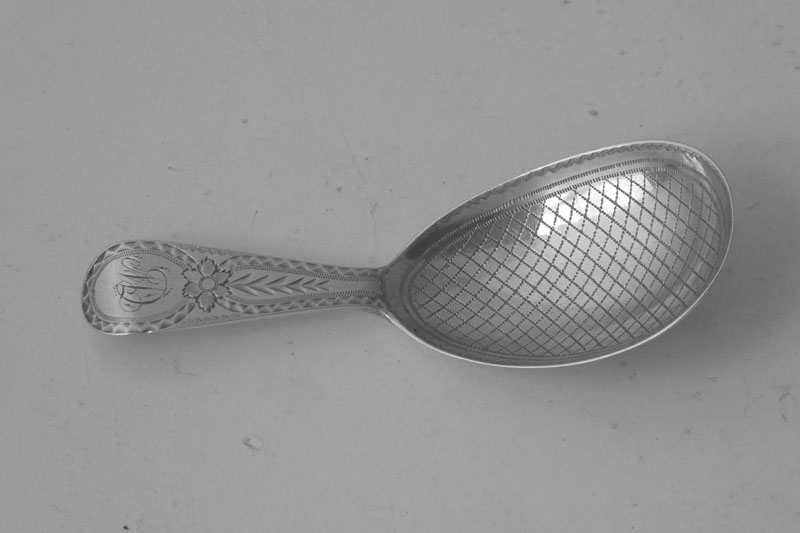
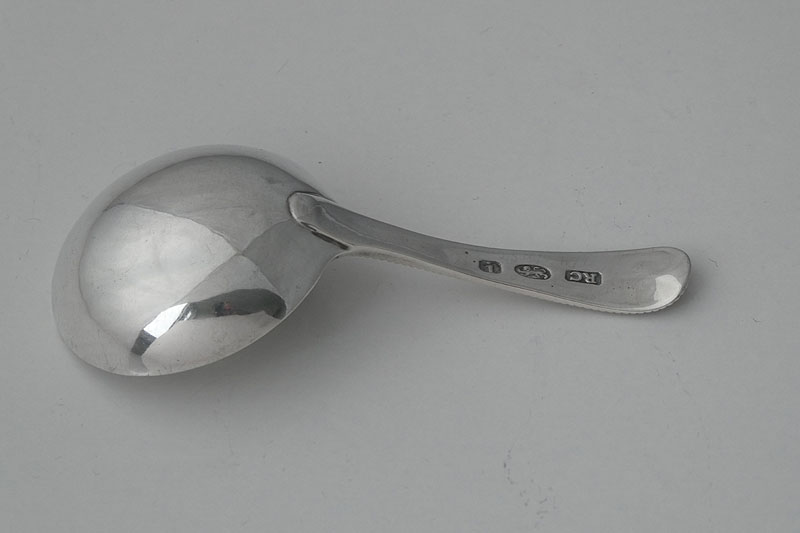
A George III caddyspoon with cuff handle and bright-cut decoration on both the front of the handle and the back of the bowl and the handle made in London in 1783 (possibly by George Smith), crested with a dog. Price: This design does not appear in Caddyspoons by John Norie (1998) or his supplement (2008).
|
9238 |
 |
A George III Old English pattern caddyspoon with a Celtic point terminal, bright-cut engraving and a fluted bowl made in Dublin circa 1800 by Jonas Osborne. Price:
|
8838 |
|
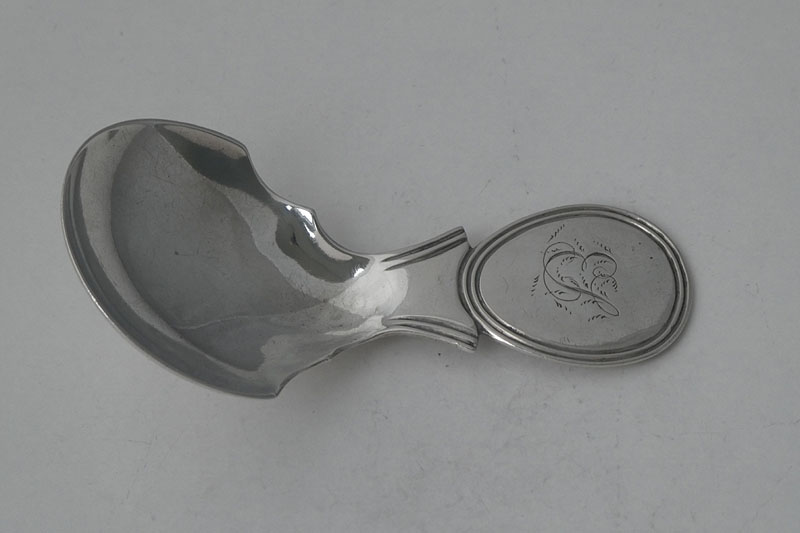
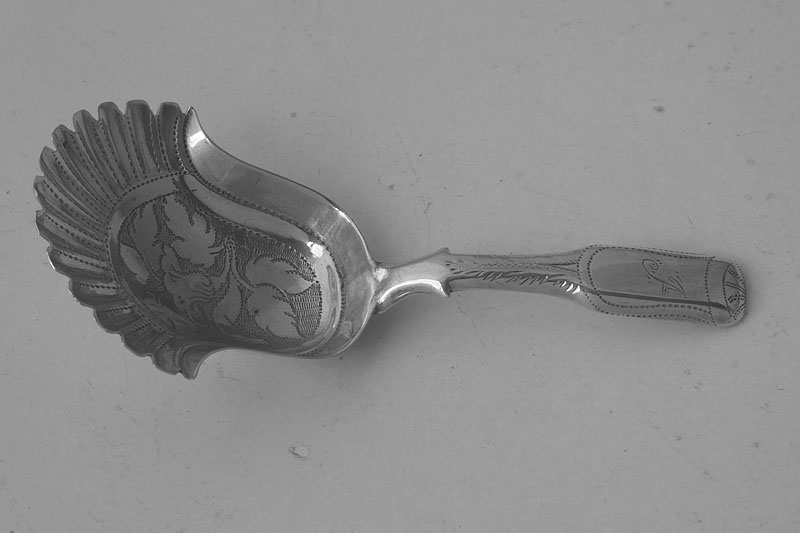
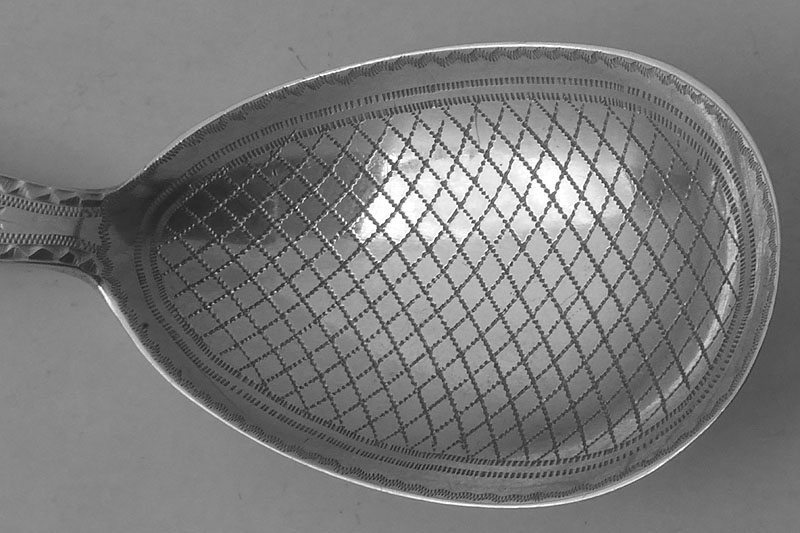
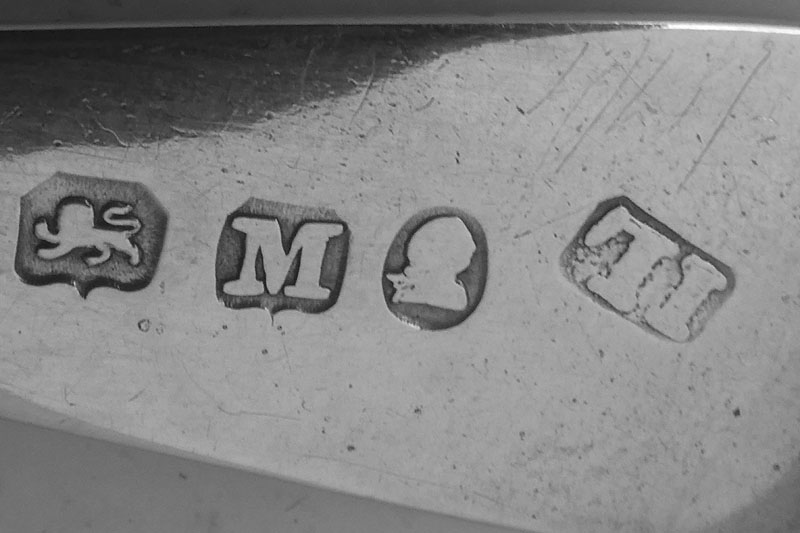
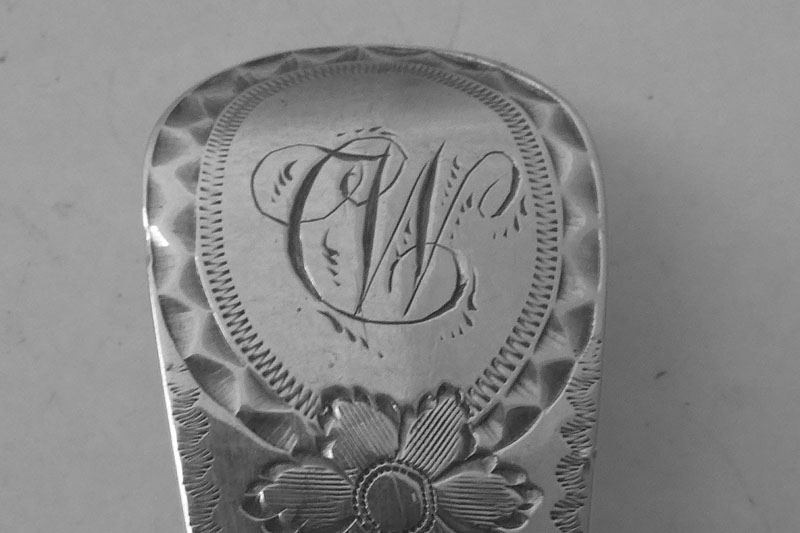
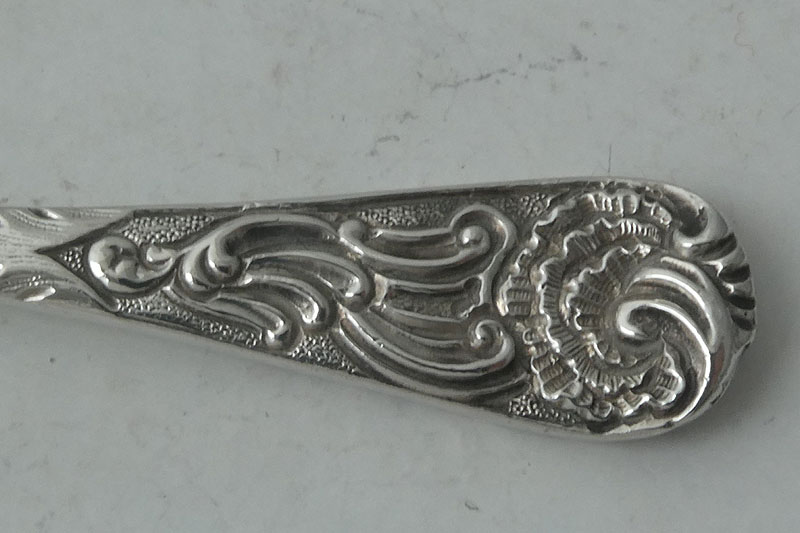
A George III caddyspoon with an engraved oval bowl made in London in 1807 by John Lias, initialled {CW}. Price: £275.00
|
1178 |
|
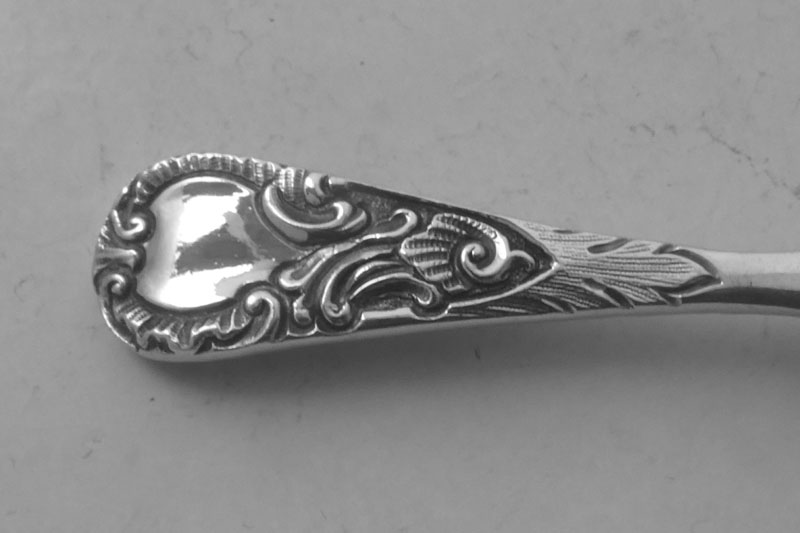
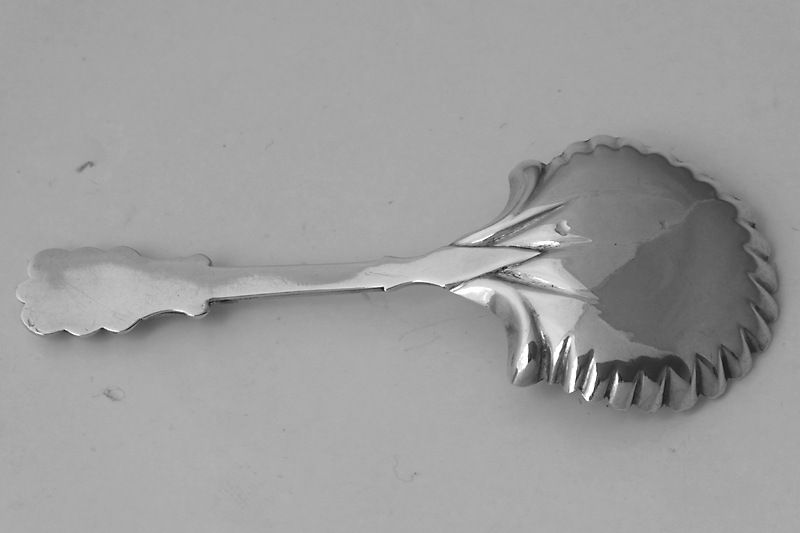
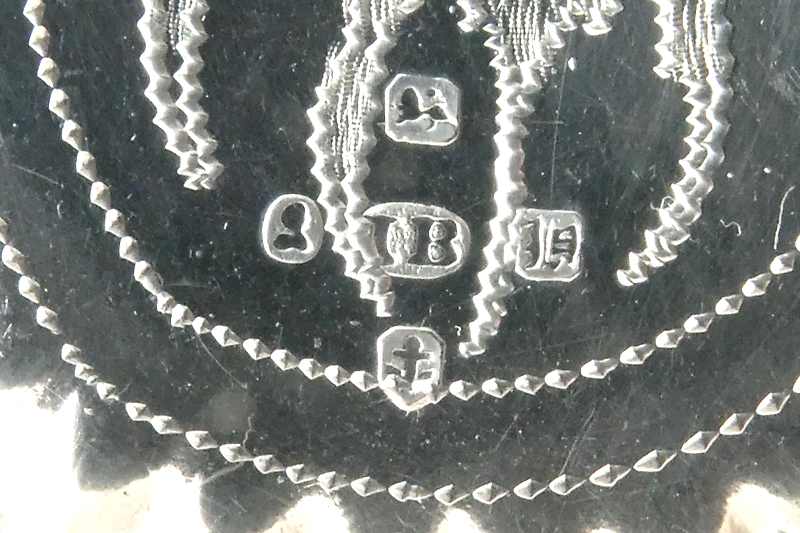
A Victorian caddy spoon with a scalloped bowl and a rococo front and back (modelled on a pattern found on 18th century teaspoons) made in London in 1866 by George Adams. Price: £275.00 This design does not appear to have been catalogued by John Norie in his published works.
|
1166 |
|
A George III caddyspoon with bright-cut decoration made in London in 1796 by Thomas Wallis, initialled {K}. Price: £275.00
|
1022 |
|
A George III Fiddle pattern caddyspoon with bifurcated stem and heart shaped bowl made in London in 1802 by Josiah Snatt, initialled {SB}. Price: £245.00
|
1020 |
 |
A George III Hourglass pattern caddyspoon with fluted bowl, by Christopher Eades Dublin 1822 (retailed by West), initialled {EJ} . Price: £245.00 |
7732 |
 |
A Victorian caddyspoon, by Martin, Hall and Company Sheffield 1860, crested with an eagle displayed . Price:  |
7927 |
 |
A fiddle pattern sugar spoon, by George Lowe Chester 1827, initialled {W}. Unusually, there is apparently no reference to this piece in the published transcripts of the Chester Duty Book which listed every item on which duty was paid (see Ridgway volume 3) |
4948 |
|
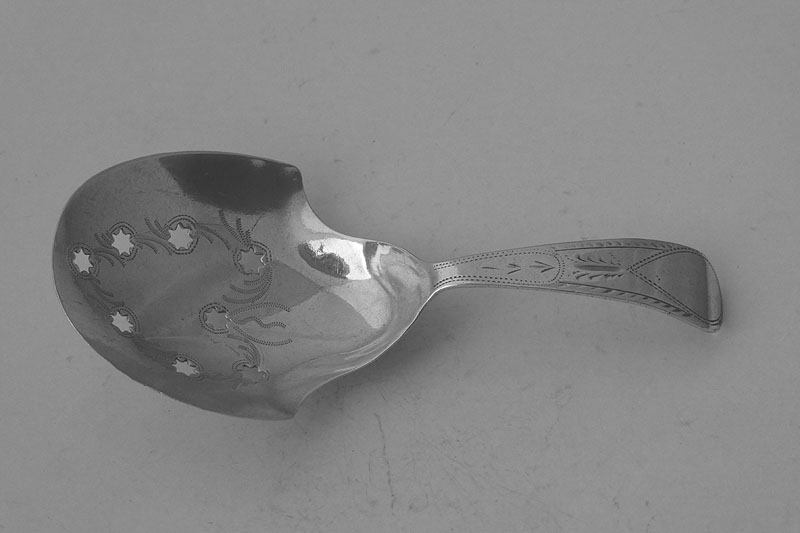
A George III Old English caddyspoon with bright-cut decoration and keyhole pierced bowl made in Birmingham in 1811 by Joseph Taylor. Price: £245.00
|
1047 |
|
A Victorian Fiddle pattern caddyspoon with pierced bowl made in London in 1853 by W. R. Smily, crested with a cubit arm holding a dagger. Price: £225.00
|
9900 |
|
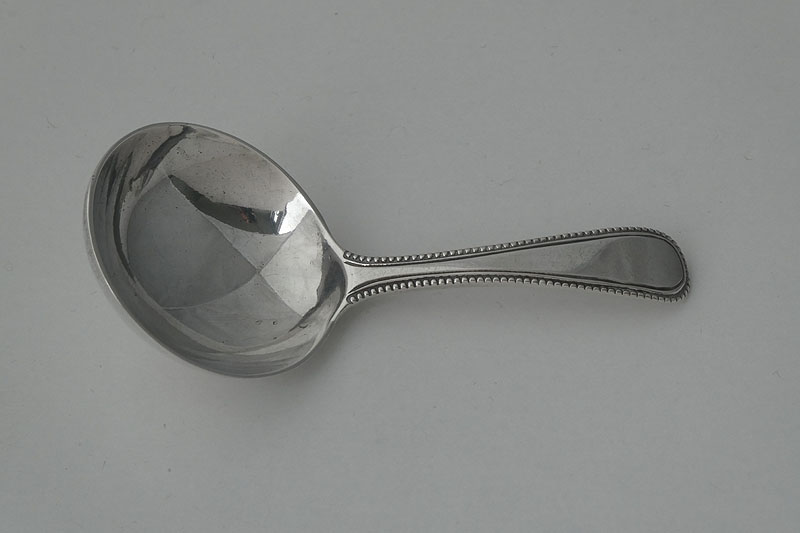
A George III Old English pattern caddyspoon with beaded borders made in London in 1784 (before the introduction of the duty mark) by Richard Crossley. Price: £225.00
|
1257 |
|
A George IV caddyspoon with threaded borders made in Birmingham in1822 by Joseph Wilmore, initialled {ES}. Price: £225.00
|
1258 |
 |
A George III shovel shaped caddy spoon with a silver handle (stamped with a maker's mark) made in Birmingham in 1813 by Joseph Taylor, the handle initialled {WBC}.
|
8346 |
 |
A George III Fiddle pattern caddyspoon with long fluted bowl made in Dublin in 1813 by Richard Sawyer, initialled {EB} Price: £225.00
|
8609 |
|
A George IV Fiddle pattern caddyspoon with engraved bowl made in Birmingham in 1823 by Joseph Taylor, initialled {F} Price: £215.00
|
1181 |
|
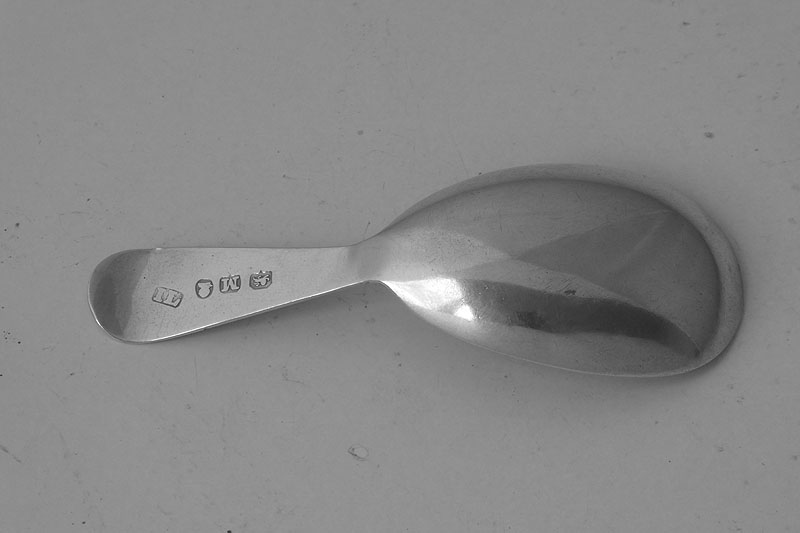
A George III caddyspoon with a leaf shaped bowl made in London in 1800 by Thomas Wallis, initialled {M}. Price: £210.00
|
9750 |
|
A George III Fiddle pattern caddyspoon with an unusually large bowl (with internal Vitruvian scroll border) made in London in 1813 by Thomas James. Price: £210.00
|
9691 |
|
A George III caddyspoon with an engraved shovel bowl and a t-shaped handle made in Birmingham in 1813 by Lawrence & Company. Price: £210.00
|
9695 |
|
A William IV caddyspoon with fluted bowl made in Birmingham in 1831 by John Betteridge. Price:
|
9641 |
|
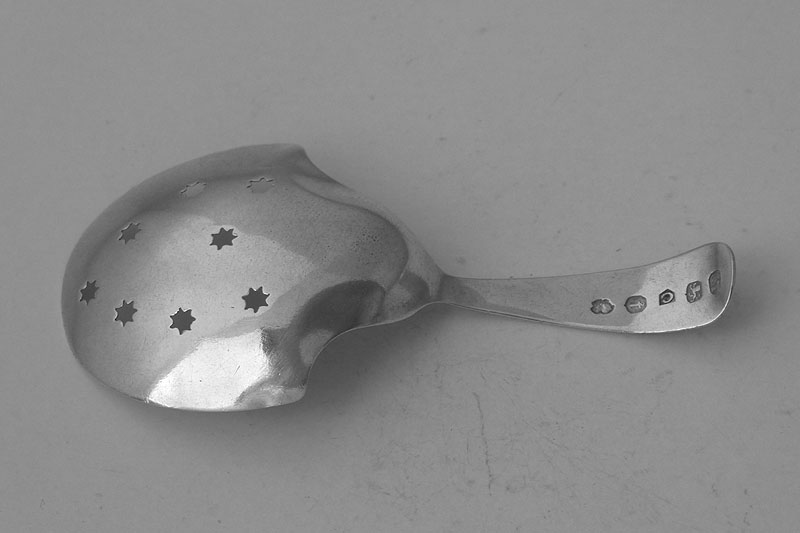
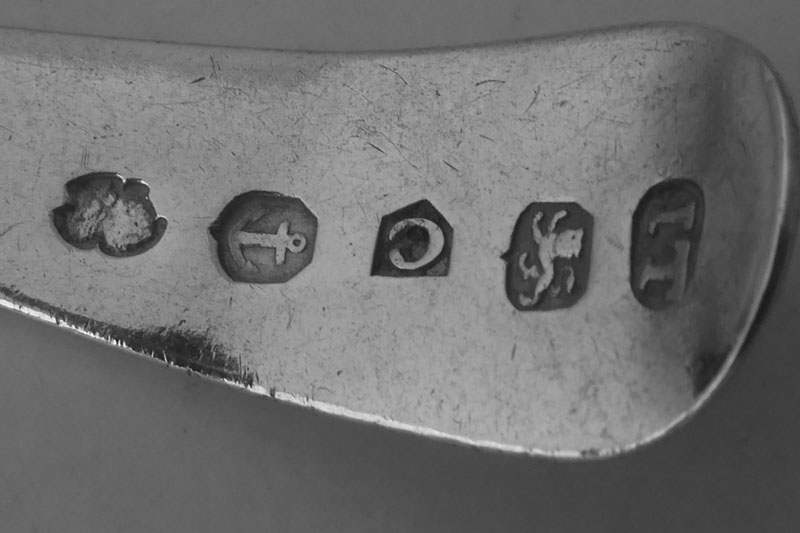
A George III caddyspoon with bright-cut decoration and a star pierced bowl made in Birmingham in 1800 by Joseph Taylor. Price: £185.00
|
1180 |
|
A George III caddyspoon with a threaded handle made in London in 1794 by Thomas Wallis. Price: £185.00
|
9747 |
 |
A brightcut caddyspoon, by Thomas Wallis London 1801 . Price: £180.00 |
5899 |
|
A George III caddyspoon with bright-cut handle and rectangular bowl made in Birmingham in 1816 by Cocks and Betteridge, initialled {K}. Price: £175.00
|
1096 |
|
A George III Hourglass pattern caddyspoon with part fluted bowl made in Birmingham in 1818 by Joseph Taylor. Price: £175.00
|
9389 |
 |
A John VI Caddyspoon with fluted bowl made in Lisbon circa 1810 by Francisco Antonio De Almeida, initialled {R}. Price: £175.00
|
9031 |
|
A George III Old English Thread pattern caddyspoon with a fluted bowl made in London in 1794 by Richard Crossley, crested with a lion's head erased and collared. Price: £165.00
|
1080 |
|
A Victorian Queen's pattern caddyspoon, made in London in 1844 by George Adams. Price:
|
9495 |
 |
A Victorian Fiddle pattern caddyspoon made in London in 1838 by Samuel Hayne and Dudley Cater. Price: £165.00
|
8679 |
 |
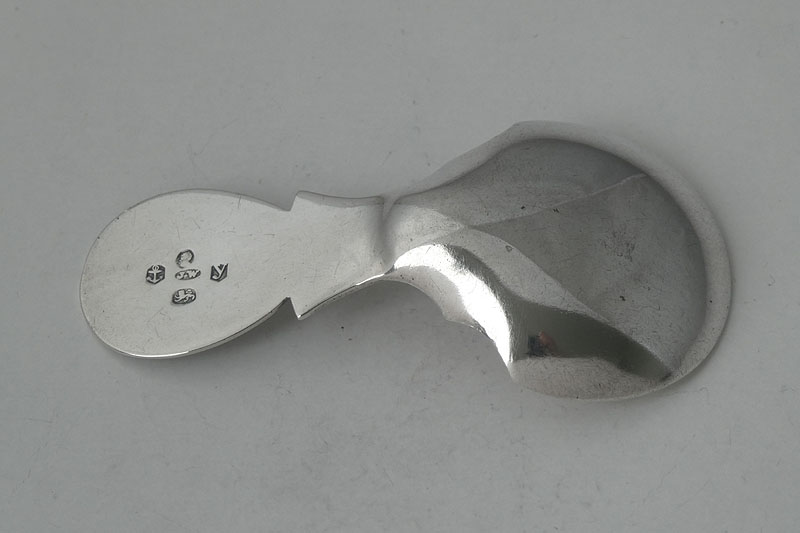
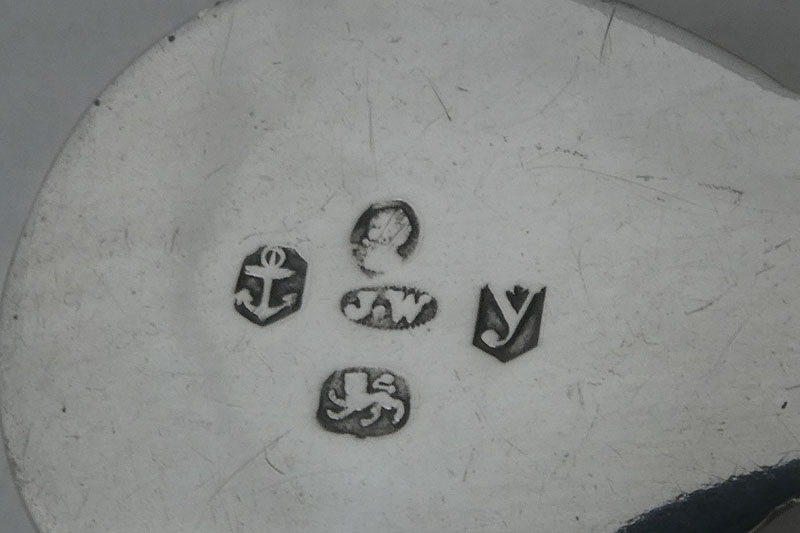
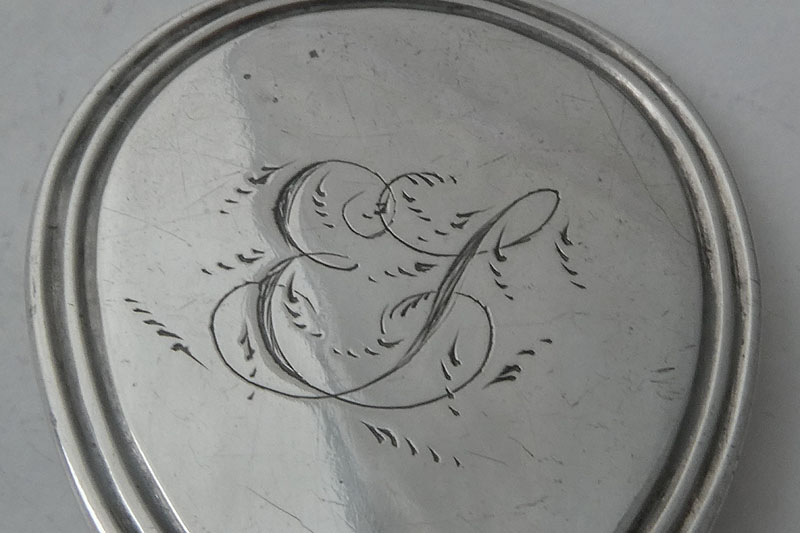
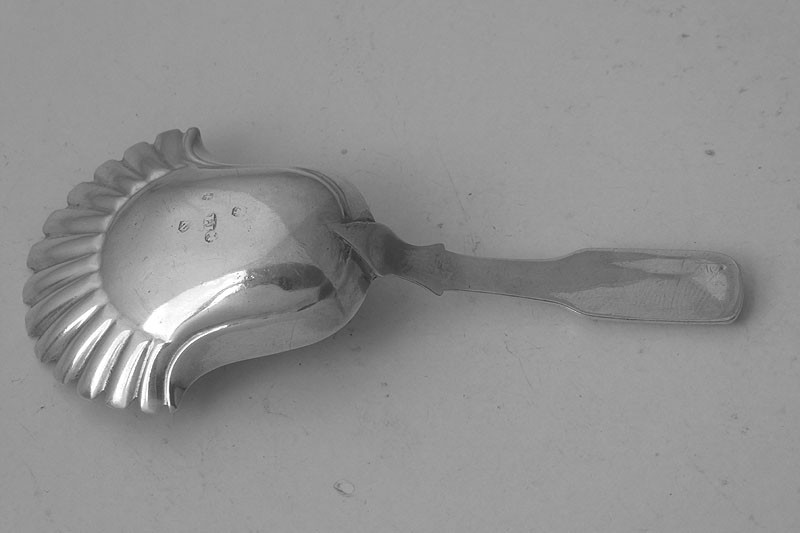
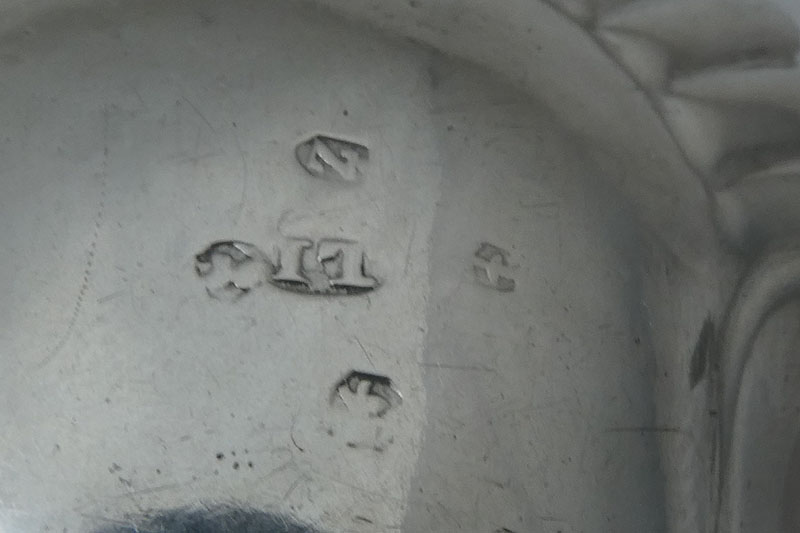
A George III Old English Thread pattern caddyspoon made in London in 1807 by Josiah Snatt, initialled {Y}. Price: £155.00
|
8680 |
|
A George VI honey spoon of unusual length (19.4 cm) and design made in London in 1938 by R. E. Stone. Price: £145.00 Robert Edgar Stone (1903-1990) was, arguably, one of the most important silversmiths of the 20th century. He was the son of a carpenter and nearly lost his arm in a childhood accident. From 1917 to 1919 he was able to attend the Central School of Arts in London via a trade scholarship from the Goldsmiths' Company in London. He went on to receive the first ever Travelling Scholarship given by the Company. Stone was then formally apprenticed to The Tudor Art Metal and Plating Company, again through the Goldsmiths' Company, in 1919. He would be made a Liveryman of the Company in 1939) and founded his own workshop in Garrick Street in 1929 (above the offices of D. and J. Welby Limited). Stone was known for the innovative design and the high quality of the goods he produced. In 1964 Stone left London and moved to Edinburgh where he registered a maker's mark and worked until 1980. It is typical of Stone that he has made the design and size of this honey spoon very different from other examples produced at the time.
|
9396 |
 |
A bright-cut caddyspoon, by Thomas Wallis London 1804 . Price: £145.00 |
6080 |
 |
A Victorian parcel gilt naturalistic sugar spoon, by Chaplin and Company London 1902 . Price: £130.00 |
7282 |
| A Dutch fiddle-thread pattern caddy spoon or medicine spoon Amsterdam 1843 by 'crowned H in a rectangle'. Price: £125.00 |
4311 | |
 |
A caddy spoon with acorn bowl, by Thomas Bradbury and Son assayed at Sheffield in 1915 . Price: |
6260 |
|
An unusually long (20.2cm) George V Old English pattern chutney spoon with feather-edge border made in London in 1931 by the Goldsmiths and Silversmiths Company. Price: £95.00
|
9524 |
|
A William IV Fiddle pattern jamspoon made in Newcastle in 1833 by John Wright, crested with a talbot's head out of a ducal coronet (possibly Southouse). Price: £85.00
|
9692 |
|
A George V silver honey spoon of customary form assayed in Sheffield in 1930 by Cooper Brothers and Sons (with Registered Design number 567914). Price:
|
9453 |
|
A George V honey spoon of customary form made in Sheffield in 1947 by Roberts and Belk (also struck with patent number). Price: £75.00
|
9279 |
 |
A George V honeyspoon of conventional form, by Roberts and Belk Sheffield 1925 (accompanied by a Registered Design number and trademark symbol). Price:£75.00 |
7022 |
 |
An Elizabeth II honey spoon of conventional form, by Roberts and Belk Sheffield 1961, also struck with patent number. Price:£75.00 |
8118 |
 |
A George V honeyspoon of conventional form with feather-edged border, by Roberts and Belk Sheffield 1936 by Roberts and Belk (accompanied by a Registered Design number and trademark symbol), initialled {A} . Price: £75.00 |
7023 |
 |
An engraved jamspoon Birmingham, 1884, George Unite. Price: £70.00 |
2956 |
| An engraved jamspoon Birmingham, 1884, George Unite. Price: £70.00 |
2957 | |