- Search Engine
- | About us
- | Index
- | History
- | The way we operate
- | Buying from us
- |
Our forthcoming Fairs - | Email us
- | Index of Research
- | Exchange Rates
- | Privacy & Security |
Butter knives and small servers

Click on |
Description — clicking on underlined text brings up extra full size images of each piece |
Stock number |
|
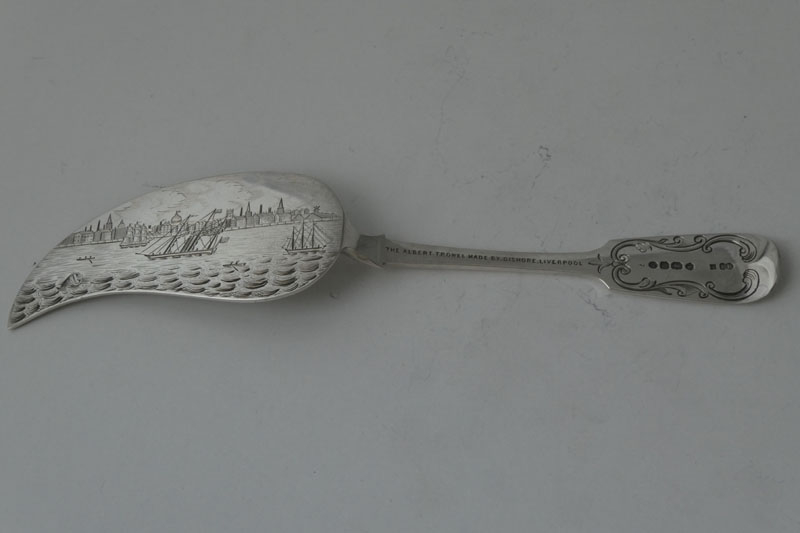
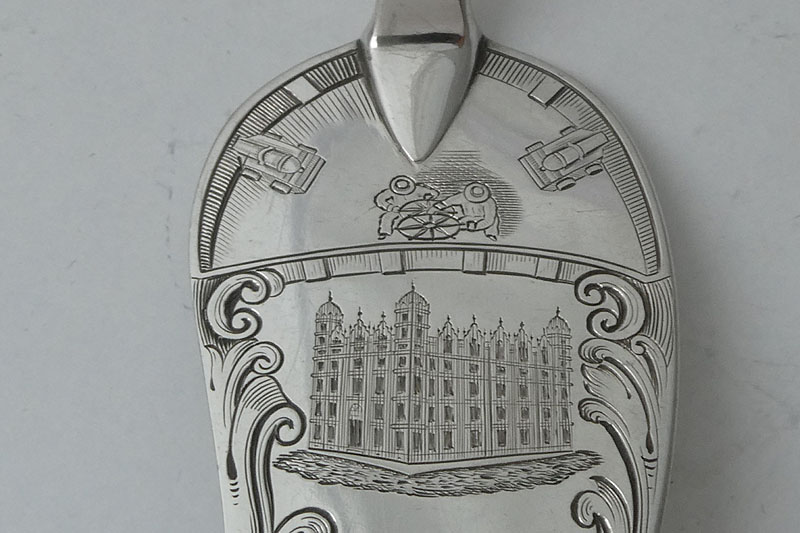
A Victorian Fiddle pattern pastry slice with engraved stem (19.9 cm long) made in London in 1847 by Elizabeth Eaton, engraved with the Sailors' Home in Liverpool and a sky line of Liverpool from the river. It is also engraved 'The Albert Trowel made by Dismore, Liverpool'. Price: £875.00 In 1846 Prince Albert, the Prince Consort and husband of Queen Victoria, became the first member of the Royal family to make a state visit to Liverpool. Among his activities during this visit Albert officially opened the Albert Dock (renamed the Royal Albert Dock in 2018), the first structure to be built from stone, brick and cast iron but without a wooden substructure, and laid the first stone of the Sailors' home. This project was first mooted in 1844 to alleviate social problems stemming from the large numbers of ship's crew in the port who were often homeless between voyages. The design by John Cunnigham had been agreed by 1846 (when it appears on the ceremonial trowel) and it was completed by 1852. The home suffered from a serious fire in 1860 and was demolished in 1974-1975 but the site remained unused until the construction of the shopping centre Liverpool One in 2004. The wrought iron gates have been restored and returned to near their original location and the Liver bird crest from the building is now housed in Liverpool Museum. The Museum also owns a letter from Thomas Dismore and Son, London describing the trowel to be used by Prince Albert- the trowel was also illustrated in the Illustrated London news for the 1st of August 1846. It is more elaborate than this example but shares many decorative and design features. It is to be presumed that, due to the unusually high quality of the engraving, this trowel was made for, or presented to, someone of consequence associated with the project.
|
9951 |
|
A George III Old English Thread pastry slice (23.7 cm long) with bifurcated stem and pierced blade made in London in 1789 by George Smith and William Fearn, crested with a talbot sejant. Price: £595.00
|
9773 |
|
A George III Old English Thread pattern pastry slice made in London in 1791 by George Smith and William Fearn. Price: £275.00
|
9149 |
 |
A Victorian spade ( approx. 7 " long) by Ephraim Tysall London 1890. Ephraim Tysall (1828-1896) was listed as an electroplater in 1866 and 1867 with an address in Melton Street, Euston Square. In 1867 Tysall moved to 24 Poland Street in Soho and is recorded there until his death (the firm continued until after 1918). According to advertisements the firm was founded in 1853 and won the '1st Prize and Diploma of Honour [at the] National Workmen's Exhibition 1893'. Despite their speciality being 'Electroplating and Gilding on any metal. Plating by dynamos only' the firm registered maker's marks with the London Assay Office in 1867 and 1888- suggesting a subsidiary trade in silver when required from early in their incorporation (a few silver pieces are noted from the 1870s onwards). |
8159 |
 |
A small server with engraved blade and engraved and beaded handle, by Martin, Hall and Company Sheffield 1878 (also marked on the handle). Price: £150.00 |
6818 |
|
A Victorian butterknife with Solomonic column stem with cartouche made in London in 1860 by Francis Higgins, crested for Robertson. Price: £140.00 This pattern was one of those on display on the stand displaying the work of Francis Higgins at the Great Exhibition held in London in 1851. The editor of the illustrated guide to the exhibition featured it on page 26 of the catalogue.
|
9455 |
 |
A fiddle pattern pastry slice, by Mary Chawner London 1835, engraved with the original crest of Colebrooke beneath a later Baron's coronet . |
6406 |
 |
A George III Fiddle Shell pattern butterknife with kidney shaped blade, by McHattie and Fenwick (active 1799-1807) Edinburgh circa 1805, crested with a demi lion rampant holding a buckle. The crest could be that of two families Ferguson of Raith, near Kirkcaldy in Fife or Johnston-Stewart of Physgill House , Wigtownshire. If this was made for the Fergusons of Raith then the holder of the estates in the early 19th century was Robert Ferguson (1769-1840). Ferguson was painted in his youth by Sir Henry Raeburn as one of the two figures in The Archers (now in the National Gallery in London). He was also a noted amateur geologist and was elected to the Royal Societies of London (1805) and Edinburgh (1806)- in the late 19th century the mineral Fergusonite was named after him. He also had a politicial career serving as Member of Parliament for Fife from 1806-1807 and then for other boroughs from 1831 until his death and was also Lord Lieutenant of Fife from 1837-1840. The gap in this career can be partially explained by the fact that in 1807 an affair with Raith caused the divorce of the independently wealthy Mary, Countess of Elgin from her husband (now best known for his acquisition of the Elgin Marbles from the Parthenon). The Earl of Elgin received £10,000 damages (approximately five million pounds in 2016) from Raith for Criminal Conversation (adultery) with the Countess. Following the divorce Raith and Mary married in 1808- he died in 1840 and she died in 1855. |
8105 |
|
A Victorian butterknife with architectural handle made in Sheffield in 1870 by Remy Martin, Edward Hall & Company (also bearing both hallmarks and maker's mark on the handle). Price: £110.00
|
9745 |
|
A Victorian butterknife with architectural handle made in Sheffield in 1870 by Remy Martin, Edward Hall & Company (also bearing both hallmarks and maker's mark on the handle). Price: £110.00
|
9745 |
|
A George IV Old English butterknife with beaded borders made in London in 1825. Price: £110.00
|
9456 |
 |
A cased fiddle pattern butter-knife,the symmetrical blade engraved with a border London 1880 by Aldwinkle and Slater initialled {GJN}. Price: £95.00 |
9266 |
|
A Victorian Onslow pattern butter knife made in London in 1866 by the Lias Brothers. Price: £90.00
|
9148 |
 |
A butterknife with a sculpted ivory handle, by Martin, Hall and Company Sheffield 1871 . Price: £75.00 |
6057 |
 |
An engraved fiddle pattern butterknife, by George Adams London 1854, crested for Robson-Scott of Ashtrees or Newton (both in Roxburghshire). Price: £75.00 |
5838 |
 |
A mother-of-pearl handled butter knife, Birmingham 1870 by Hilliard and Thomasson. Price: £72.00 |
4071 |
 |
A mother-of-pearl handled butterknife, Sheffield 1849 by Aaron Hadfield, initialled {MG}. Price: £65.00 |
3156 |
|
A Victorian butter knife with a mother-of-pearl handle made in Birmingham in 1871 by Hilliard and Thomasson. Price: £58.00
|
9459 |